
What does an accessible bathroom cost in the Highlands and Islands?
Our guide range in the Highlands and Islands is £5,800–£13,500 including VAT. Prices in the Highlands and Islands run at about 4% below the UK guide, based on Scotland labour rates. Travel and delivery to islands and remote areas are priced on your quote.
Level-access shower
- Slip-resistant floor
Accessible wet room
- Level floor throughout
Walk-in or low-level bath
- Thermostatic filler
Guide prices for Highlands & Islands including VAT. Your itemised written quote after the free survey is the price that counts.
Which towns do we cover in the Highlands and Islands?
Water across much of the Highlands and Islands is soft. If that holds for your street in Inverness, limescale on shower glass and heads builds up slowly and a squeegee after use is usually enough. Hardness varies street by street, so check the figure for your postcode with your water supplier. We can work alongside an occupational therapist assessment for your Inverness home, so the rails and seat go where they are needed.
What the job includes
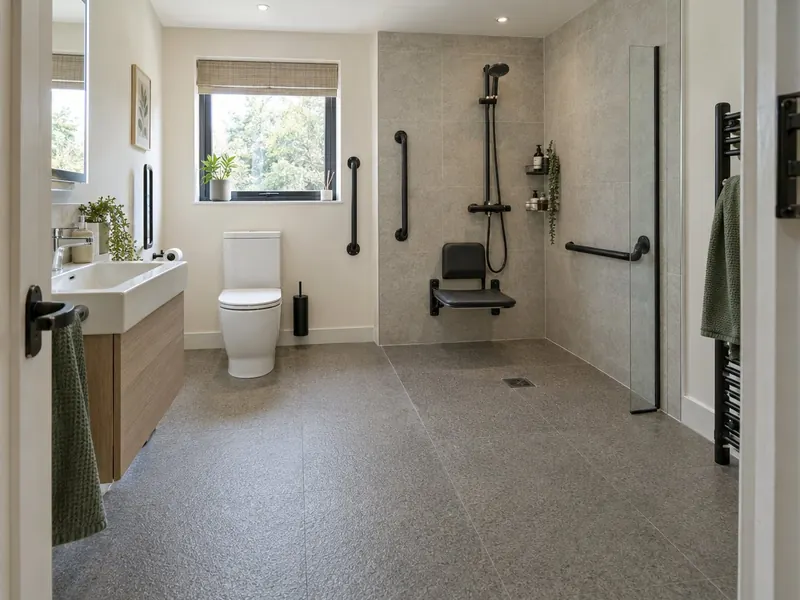
- Removal of the bath and a level-access or low-profile shower in its place, or a full level-floor wet room
- A home survey of how the room is used now and what needs to change, including door width and turning space
- Slip-resistant floor tiles or safety flooring that grips when wet
- A thermostatic shower valve, so the temperature stays safe and steady
- A comfort-height WC, with support rails where needed
- A fold-down shower seat and grab rails fixed into solid wall or timber backing fitted behind the boards
Decisions to make first
Walk-in bath
A door or low-entry bath suits people who want to keep bathing, but you have to sit inside while it fills and drains.
Seat
A wall-mounted fold-down seat saves space and stays put. A freestanding shower stool is portable but takes floor space and can shift.
Rail positions
Rails go where you need support: beside the WC, at the shower entry and near the seat. We set heights with the user at the survey so they suit their reach.
Colour contrast
Contrast between floor, walls, rails and the WC seat makes the room easier to use for people with sight loss or dementia.
Rules that apply in Scotland
Building work to adapt a home for a disabled person can be zero-rated for VAT under HMRC VAT Notice 701/7. It is not means-tested; the person signs an eligibility declaration before work starts. Disabled Facilities Grants and similar schemes are means-tested and need council approval before any work begins. All electrics must meet BS 7671, with 30 mA RCD protection on every circuit.
Scotland does not have Disabled Facilities Grants. Councils run a Scheme of Assistance instead, which can help with adaptations, so contact your council before planning the work. A building warrant may be needed if the drainage is altered for a level-access floor.