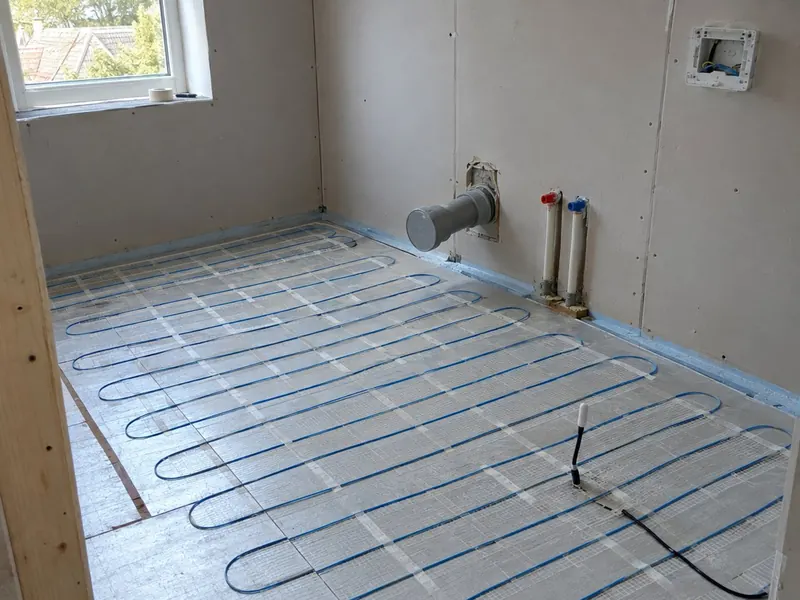
Underfloor heating makes the most sense when a bathroom floor is coming up anyway. A thin electric mat on an insulation board raises the floor by roughly a centimetre and is laid in a day as part of the fit. It warms the floor rather than the air next to a radiator, so the tiles stop feeling cold underfoot and wet footprints dry quickly. In a small room it usually works alongside a heated towel rail rather than replacing it.
An electric mat for a typical bathroom costs £700 to £1,500 including VAT, with the thermostat and an RCD-protected supply connected by a qualified electrician. Covering a larger floor with a programmable smart thermostat runs £1,200 to £2,200. A wet system connected to the central heating costs £1,500 to £3,000 and suits larger rooms, or homes where the heating is already being altered.
What does bathroom underfloor heating with us include?
- A check of the floor construction, the room's heat loss and where the thermostat and supply will go
- Insulation boards over the subfloor, so heat goes up into the tiles rather than down into the joists or screed
- The electric mat or cable laid to the open floor, kept clear of where the WC, bath and fixed furniture will sit
- A floor sensor set between the heating runs and wired back to the thermostat
- Resistance and insulation tests on the mat before, during and after tiling, with the readings recorded
- A dial, programmable or smart thermostat, with the supply RCD protected, tested and certified by a qualified electrician
- For wet systems, pipes in low-profile boards or screed connected to a manifold or single-zone kit, with any boiler work done by a Gas Safe registered engineer
- Bringing the system up to temperature gradually once the adhesive and grout have cured
How much does bathroom underfloor heating cost?
Our UK guide range is £700–£2,500 including VAT. Typical prices by kind of job:
Electric mat
- Mat under the tiles
- Insulation board
- Thermostat and RCD-protected supply
Electric, larger room
- Whole floor coverage
- Programmable smart thermostat
- Electrician sign-off
Wet system
- Pipes linked to the heating
- Manifold or single-zone kit
- Screed or low-profile boards
National guide prices including VAT, reviewed October 2026. London is typically about 25% higher and the North East, Wales and Northern Ireland around 7–12% lower. Your written quote after the survey is the price that counts.
What do you need to decide?
Electric or wet
Electric is cheaper to install and quick to lay in one room. Wet costs more upfront but is usually cheaper to run where it is fed by a gas boiler or heat pump.
Mat or loose cable
Mats are quickest on square, open floors. Loose cable is easier to route around awkward shapes, pipe boxing and a curved shower area.
Insulation board thickness
Thicker boards warm up faster and lose less heat downwards, but raise the floor; the right choice depends on the door threshold and the next room.
Thermostat
A simple dial thermostat, a programmable one with set times, or a smart thermostat you can control from your phone.
Floor finish
Tiles and stone pass heat through well. LVT and vinyl can work, but check the maximum floor temperature the flooring maker allows.
Floor heating and towel rail
Underfloor heating warms the room; a towel rail dries towels. Many bathrooms have both, and a dual-fuel rail keeps working in summer when the boiler is off.