
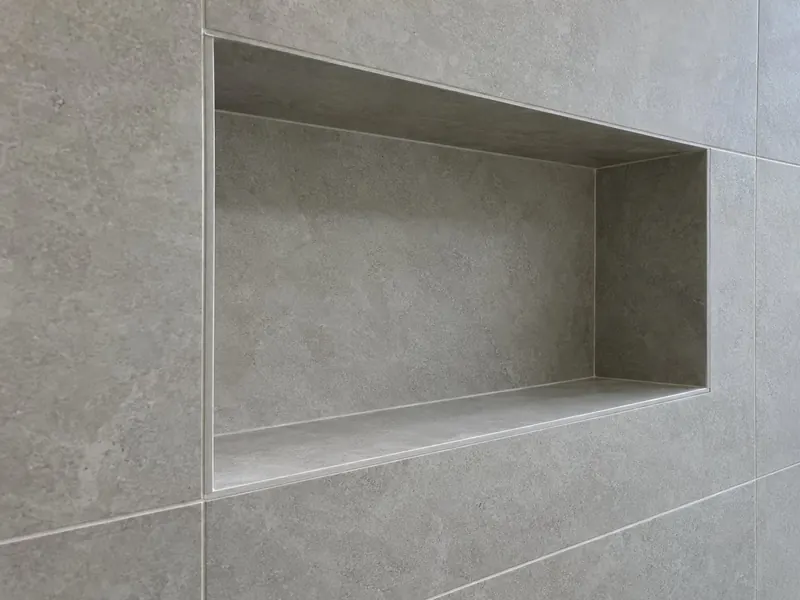
What is the difference between porcelain, ceramic and stone tiles?
Porcelain tiles are made from fine, dense clay fired at a higher temperature than ceramic, so they absorb almost no water and resist wear; ceramic tiles are softer, lighter and cheaper; natural stone is quarried rock such as marble, limestone, travertine or slate, and every piece is different.
In a bathroom that difference matters. Porcelain absorbs less than 0.5% of its weight in water, which makes it the safe choice for floors, shower walls and wet rooms. Through-body porcelain has the same colour all the way through, so a chip shows less. Ceramic is perfectly good on walls and in areas that only get splashed, and it is easier to cut, which helps around pipes and window reveals.
Natural stone gives a look nothing else quite matches, but it is porous. It needs sealing before and after grouting and again from time to time, and acidic cleaners can etch marble and limestone. Porcelain that copies stone or concrete is the usual compromise: the look, without the upkeep.
- Porcelain: floors, showers, wet rooms, full-height walls
- Ceramic: walls, splashbacks and budget-conscious rooms
- Stone: feature walls and floors where you accept regular sealing
Which bathroom floor tiles are least slippery?
The least slippery bathroom floor tiles have a matt or textured surface and a tested slip resistance of R10 or above, or a pendulum test value (PTV) of 36 or more when wet.
You will see three kinds of slip figure on tile specifications:
- R ratings (R9 to R13) come from a ramp test with a person in shoes on an oily surface. R9 gives the least grip; R10 is a sensible minimum for a bathroom floor; R11 suits wet rooms and shower floors.
- PTV comes from a pendulum that swings a rubber slider across a wet tile. In UK guidance, 36 or more means low slip potential, 25 to 35 moderate and 24 or below high.
- Barefoot classes A, B and C are tested with bare feet on a soapy wet surface, so they are the most relevant figure for a walk-in shower or wet room floor. Class B or C suits a shower floor.
Polished and high-gloss tiles look smart but can be slippery when wet, so keep them for walls. Smaller tiles on a shower floor give more grout lines, which adds grip and makes it easier to form a fall to the drain. If anyone in the home is older or unsteady on their feet, choose the higher end of the scale.
Are large-format tiles a good idea in a bathroom?
Large-format tiles, usually 600 × 600 mm or bigger, suit most bathrooms because fewer grout lines make the room look larger and easier to clean, but they need a very flat surface and more careful fitting.
A big tile will not bend to follow a wavy wall or a springy floor. Walls are often boarded or skimmed flat first, and timber floors are stiffened with plywood or cement-based tile backer board so they do not flex. The tiler spreads adhesive on the back of each tile as well as the wall, so there are no hollow spots, and uses a levelling system to stop neighbouring edges standing proud.
Large tiles do not work well everywhere:
- Shower floors sloping to a centre drain, where a big flat tile cannot follow four falls. A linear drain with a single fall solves this.
- Small rooms with many cuts around pipes, boxing and window reveals, where waste goes up.
- Heavy natural stone on plasterboard walls, which may be more weight than the board can carry.
In our guide prices, large-format and stone tiling is £85–£130 per m² supplied and fitted, against £60–£90 for standard porcelain, because of the extra preparation and handling.
Which grout should you use in a bathroom?
For most bathrooms a flexible, water-resistant cement-based grout is the right choice, with epoxy grout worth paying for in showers, wet rooms and anywhere staining or mould is a worry.
- Cement-based grout is easy to apply and repair and comes in many colours. Choose a flexible version for floors and any surface that might move, such as boarded walls or a heated floor.
- Epoxy grout is a resin that sets hard and does not absorb water, so it resists stains and mould far better. It is slower and fiddlier to apply, which adds labour.
Joint width depends on the tile. Rectified tiles, which have precisely cut edges, can be laid with narrow joints of around 2 mm on walls; tiles with softer, uneven edges need wider joints. Colour changes the look more than people expect: a matching grout hides the joints, a contrasting one makes the grid a feature, and mid-grey forgives dirt better than bright white on a floor.
One rule never changes. Internal corners, the joint between the tiles and the bath or shower tray, and the edges of the floor are movement joints. They are sealed with sanitary silicone, not grout, because grout cracks when the bath or tray moves under weight.
How much does bathroom tiling cost per m²?
Bathroom tiling costs £45–£90 per m² supplied and fitted for most ceramic and porcelain tiles, rising to £85–£130 per m² for large-format porcelain or natural stone.
| Tile type | Guide price per m², supply and fit | Typical use |
|---|---|---|
| Ceramic | £45–£65 | Walls, wet areas or half-height tiling |
| Porcelain | £60–£90 | Walls and floor, full height in wet zones |
| Large-format or stone | £85–£130 | Large porcelain, marble, limestone, slate |
These are national guide ranges including VAT. London is roughly 25% above them, and the North East, Wales and Northern Ireland roughly 7–12% below. The final price depends on more than the tile: the number of cuts, how flat the walls are, niches and mitred edges, and whether the floor needs boarding first. Tiling only the wet areas costs far less than full-height tiling. See bathroom tiling or the full price guide to see how tiling fits into a complete bathroom budget.
How many tiles do you need for a bathroom?
Work out the area of each wall and floor you plan to tile in square metres, take off doors and windows, then add about 10% for cuts and breakages, or about 15% for diagonal or herringbone layouts.
- Measure the width and tiled height of each wall in metres. A wall 2.2 m wide tiled to 2.4 m is 5.28 m².
- Take off windows and doors, but not small items such as a basin or WC.
- Measure the floor, including any area under a freestanding bath you want tiled.
- Add the waste allowance, then round up to whole boxes.
Buy every box at once and check they share the same batch or shade number. Tiles from different batches can vary slightly in colour, and the difference shows once they are on the wall. Keep a few spares after the job, because a discontinued tile can be impossible to match years later.
If you are supplying your own tiles for a fit-only job, ask us to check the quantity against the room measurements before you order.
What goes behind bathroom tiles?
Behind the tiles in a well-built bathroom is a stable, water-resistant background: tile backer board or moisture-resistant board on the walls, a stiff overlaid floor, and a tanking membrane anywhere that gets soaked.
Tiles and grout are not waterproof on their own. Water works through hairline cracks in grout and soaks into plaster or plasterboard, which leads to loose tiles, mould and leaks through the ceiling below. Tanking is a liquid or sheet membrane applied to the walls and floor in shower areas, with taped corners and sealed pipe entries, so any water that gets past the tiles stays in the room. In a wet room the whole floor and the lower walls are tanked.
Old tiles are best removed rather than tiled over. Tiling over tiles adds weight, builds the walls out around the bath and window reveals, and hides any loose or hollow areas underneath.
On timber floors, the boards are screwed down and overlaid with plywood or cement-based board before tiling, so the floor does not flex and crack the grout. This preparation is what stops a new tiled floor failing in its first few years.
Questions about this guide
Is porcelain or ceramic better for a bathroom floor?
Porcelain is better for a bathroom floor. It is denser, harder wearing and absorbs almost no water, and it comes in slip-resistant finishes. Ceramic floor tiles exist, but ceramic is usually kept for walls.
What slip rating do I need for a shower floor?
Aim for R11, or barefoot class B or C, on a walk-in shower or wet room floor, and at least R10 or a wet PTV of 36 or more on the rest of the bathroom floor. Small tiles with more grout lines add grip.
Can you tile over existing bathroom tiles?
It is possible if the old tiles are firmly fixed and the wall can take the weight, but it is rarely the right choice. Removing them lets the fitter check the wall, deal with any damp and tank the wet areas properly.
Does natural stone suit a bathroom?
Yes, if you accept the upkeep. Stone needs sealing when it is laid and resealing from time to time, and it must be cleaned with pH-neutral products because acids etch marble and limestone. Stone-effect porcelain gives a similar look with less care.
Guide prices include VAT and were reviewed in October 2026. Rules summarised here are general information, not legal advice; we check what applies to your home at the survey.
Add Fitted Bathrooms as a preferred source on Google