Free home survey & written quote · Fitted bathrooms across England, Wales, Scotland & Northern Ireland0800 088 6341
Fitted Bathrooms
Furniture, finishes & services

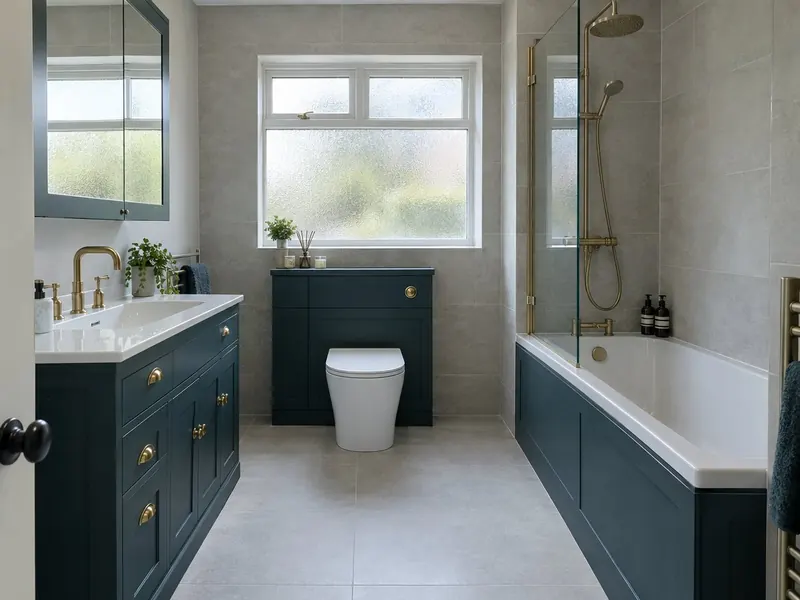
Fitted bathroom furniture, scribed wall to wall

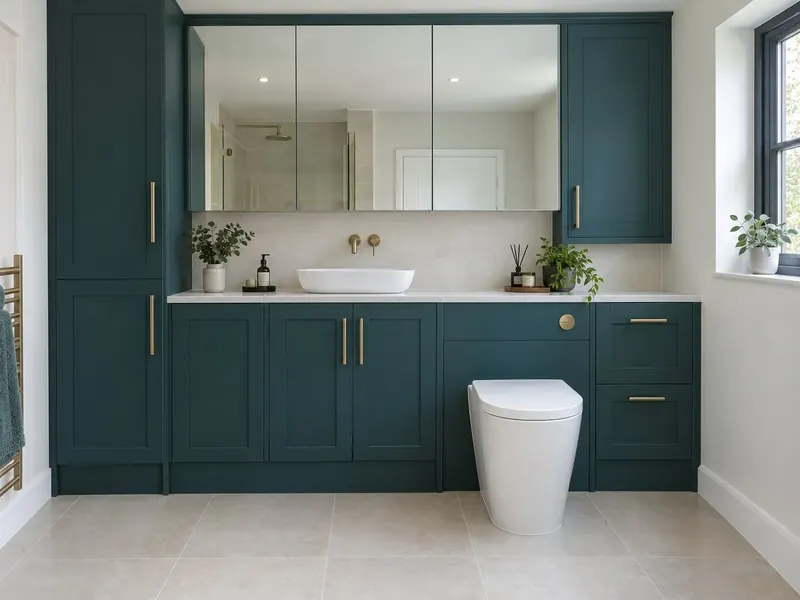
Fitted bathroom furniture is a run of cabinets, typically a vanity unit, a WC unit with a concealed cistern and tall storage, joined under one worktop and scribed to the walls, so the furniture fills the space like a fitted kitchen instead of standing as separate pieces.

From £1,200 inc VAT1–3 working daysFree home survey
Fitted bathroom furniture run with vanity, WC unit and tall storage

The difference between fitted furniture that lasts and furniture that swells within a few years is mostly in the materials and the fitting. Carcasses should be moisture-resistant board with every edge sealed, the worktop sealed to the wall, and the plinth kept clear of standing water. Fillers are cut to the real shape of the walls, which are rarely straight, so there are no gaps for water and dust to collect in.

We fit furniture runs into existing bathrooms as well as complete new rooms. A compact vanity and WC run typically costs £1,200 to £2,500 including VAT, supplied and fitted. A full run with tall storage and a quartz-effect or solid-surface top is £2,500 to £5,000, and wall-to-wall storage with mirror cabinets £4,500 to £8,000. Fitting takes one to three working days, depending on how much plumbing moves.

What does fitted bathroom furniture with us include?

  • Measuring every wall for length, height and how far it is out of square
  • Supply of carcasses, doors, plinths, fillers and end panels in your chosen finish
  • A concealed cistern or cistern frame, with an isolation valve you can reach through the flush plate or a panel
  • A worktop cut to length, with basin and tap cut-outs and sealed edges
  • Basin, tap and waste connected, and the WC pan fixed and joined to the soil pipe
  • Fillers and end panels scribed to the walls, and the worktop sealed with silicone
  • Tall units fixed to the wall, doors adjusted and soft-close hinges set
  • Removal of the old basin, WC or cabinets, with redundant supplies capped

How much does fitted bathroom furniture cost?

Our UK guide range is £1,500–£6,000 including VAT. Typical prices by kind of job:

Compact run

£1,200–£2,500
  • Vanity and WC unit with concealed cistern
  • Laminate worktop
  • Soft-close doors

Wall-to-wall

£4,500–£8,000
  • Floor-to-ceiling storage
  • Mirror cabinets and lighting
  • Made to suit awkward spaces

National guide prices including VAT, reviewed October 2026. London is typically about 25% higher and the North East, Wales and Northern Ireland around 7–12% lower. Your written quote after the survey is the price that counts.

What do you need to decide?

Carcass board

Moisture-resistant board with sealed edges is the minimum. Some ranges use a PVC-based or similar carcass that copes better with splashes and leaks.

Door style

Slab doors are the easiest to wipe down. Shaker doors look traditional but have grooves that collect dust. Handleless push-to-open doors suit a plain, modern room.

Unit depth

Slimline units are shallower and suit narrow rooms; standard-depth units hold more and give a wider worktop over the cistern.

Cistern type

A back-to-wall pan can use a cistern that sits inside the WC unit, which is simple to service. A wall-hung WC needs a load-bearing frame built in behind the run.

Tall storage

A tall unit at the end of the run takes towels and cleaning products off the floor. Check it clears the door, window and towel rail.

Lighting in the run

Plinth lights and an illuminated mirror cabinet must be planned at first fix, because the cables run inside the furniture and need RCD protection.
How does the job run?

  1. Measure and plan

    We measure every wall and set the order of units around the soil pipe, window and door.

  2. Order

    Units are ordered to size, with fillers and end panels left oversize so they can be scribed on site.

  3. Prepare

    Old fittings come out, supplies and wastes are set for the new units, and any cistern frame is fixed.

  4. Build the run

    Carcasses are levelled and fixed, the worktop is cut and fitted, and the basin and WC connected.

  5. Finish

    Doors are adjusted, fillers scribed, edges sealed and everything tested for leaks.

Who is it right for?

  • Bathrooms with exposed pipework, boxing or a soil stack you want hidden behind panels
  • Rooms where there is nowhere to put towels, toiletries and cleaning products
  • Existing bathrooms with sound tiles where only the basin and WC are being replaced
  • Long, narrow rooms where a single run along one wall makes use of the length

What should you watch out for?

  • Ask what the carcass is made of and how the edges are sealed; raw board swells once water gets into an edge
  • Make sure the cistern valve and basin trap can be reached without taking the run apart
  • Check the floor under the run: uneven floors need adjustable legs or packing so the worktop sits level
  • Plan mirror cabinets, plinth lights and shaver sockets before the run goes in, not after

What rules apply to fitted bathroom furniture?

Fitted furniture itself is not controlled by building regulations, but what goes into it is. A new WC must meet the water fittings rules, with a maximum 6-litre flush and backflow protection. Illuminated mirrors, cabinet lights and shaver points must suit the bathroom zones under BS 7671, on circuits with 30 mA RCD protection, and apart from shaver supply units, sockets must be at least 3 m from the edge of zone 1.

England

In England, wiring a lit mirror or plinth lights means altering a circuit in a room with a bath or shower, which is notifiable under Part P. The Water Supply (Water Fittings) Regulations 1999 cover the new WC and basin taps.

Wales

Wales has its own Part P with a wider list of notifiable work, so lit furniture should be connected by a registered electrician who notifies it. The water fittings rules are the same as in England.

Scotland

In Scotland, fitting furniture in an existing bathroom does not need a building warrant. New WCs and taps must meet the Scottish Water Byelaws 2014, and any wiring for lit units is tested and certified to BS 7671.

Northern Ireland

In Northern Ireland, fitted furniture does not need building control approval. The Water Supply (Water Fittings) Regulations (Northern Ireland) 2009 cover the WC and taps, and any wiring should follow BS 7671.

FAQ

Fitted bathroom furniture: your questions answered

How much does fitted bathroom furniture cost?

Fitted bathroom furniture typically costs £1,200 to £2,500 including VAT for a compact vanity and WC run, supplied and fitted. A full run with tall storage and a quartz-effect or solid-surface top costs £2,500 to £5,000, and floor-to-ceiling storage with mirror cabinets £4,500 to £8,000. Moving the WC or basin adds plumbing cost.

Can fitted furniture be added to an existing bathroom?

Yes, if the tiles behind and below the run are sound and the WC and basin can reach the existing waste positions. The run usually goes in over one to three days. Where the old tiles stopped behind a pedestal basin or around the WC, there may be gaps to fill with new tiles or panels.

What is a concealed cistern?

A concealed cistern is a toilet cistern hidden behind a panel or inside a WC unit, so only the pan and flush plate show. Back-to-wall WCs use a cistern that sits in the unit; wall-hung WCs use one built into a steel frame that carries the pan and the person using it.

What is the difference between fitted and freestanding bathroom furniture?

Fitted furniture is built in as one continuous run, with a shared worktop and fillers cut to the walls. Freestanding furniture is a set of separate units that stand or hang on their own. Fitted gives more storage and hides pipework; freestanding is quicker to install and easier to change. Our guide to fitted vs freestanding furniture compares them.

How long does fitted bathroom furniture last?

It depends on the board and the fitting more than the style. Moisture-resistant carcasses with sealed edges, a worktop sealed to the wall and a working extractor fan keep a run sound for many years. Raw edges, a leaking trap and a room without ventilation are what make furniture swell and doors drop.

Can bathroom furniture be fitted around a soil pipe?

Yes. A soil stack in the corner is usually boxed into the end of the run or hidden behind the WC unit, with the worktop scribed round it. If the stack has an access cap or rodding point, a removable panel keeps it reachable.

What is the best worktop for a bathroom?

For most bathrooms, a quartz-effect or solid-surface worktop is the hardest-wearing choice, because it resists water and stains and can be joined with almost invisible seams. Laminate costs less and works well if every cut edge is sealed. A one-piece moulded basin and top has no joints to clean at all.

Does fitted furniture work in a small bathroom?

Yes, often better than separate pieces, because a slimline run along one wall turns the space above the cistern and around the basin into storage. Short-projection pans and compact basins keep the run shallow. See small bathrooms for layouts.

Read more before you decide

Ready for a bathroom that fits properly?

Book a free home survey. You get a measured layout and an itemised written quote before any work starts.