
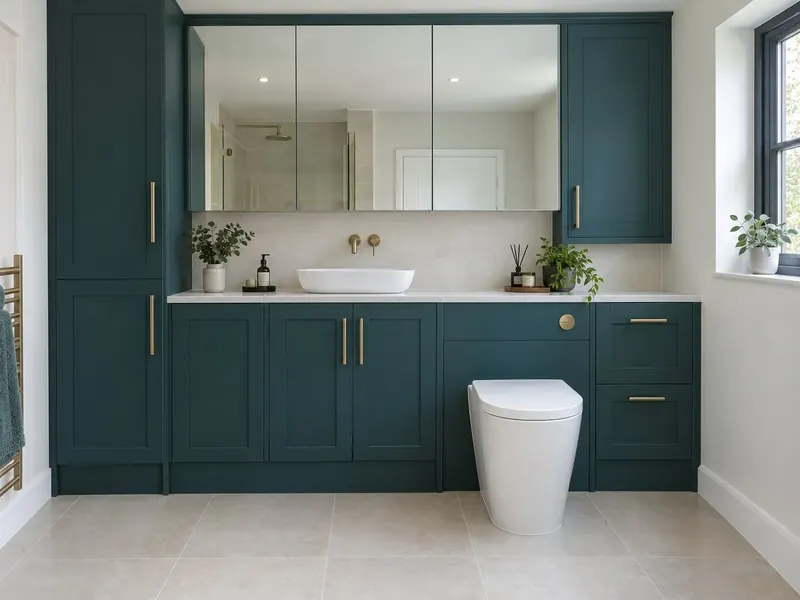
What does fitted bathroom furniture cost in Dorset?
Our guide range in Dorset is £1,550–£6,100 including VAT.
Compact run
- Vanity and WC unit with concealed cistern
Full fitted run
- Quartz-effect or solid-surface top
Wall-to-wall
- Made to suit awkward spaces
Guide prices for Dorset including VAT. Your itemised written quote after the free survey is the price that counts.
Which towns do we cover in Dorset?
Water across much of Dorset is hard. Taps, plug wastes and toilet pans scale up quickly, so chrome copes better than matt black, and a removable aerator is worth having. Hardness varies street by street, so check the figure for your postcode with your water supplier. Rented homes in Bournemouth are well served by slab doors and sealed worktops, which stand up to a change of tenants.
What the job includes
- Fillers and end panels scribed to the walls, and the worktop sealed with silicone
- Basin, tap and waste connected, and the WC pan fixed and joined to the soil pipe
- A worktop cut to length, with basin and tap cut-outs and sealed edges
- Supply of carcasses, doors, plinths, fillers and end panels in your chosen finish
- A concealed cistern or cistern frame, with an isolation valve you can reach through the flush plate or a panel
- Removal of the old basin, WC or cabinets, with redundant supplies capped
Decisions to make first
Tall storage
A tall unit at the end of the run takes towels and cleaning products off the floor. Check it clears the door, window and towel rail.
Lighting in the run
Plinth lights and an illuminated mirror cabinet must be planned at first fix, because the cables run inside the furniture and need RCD protection.
Carcass board
Moisture-resistant board with sealed edges is the minimum. Some ranges use a PVC-based or similar carcass that copes better with splashes and leaks.
Cistern type
A back-to-wall pan can use a cistern that sits inside the WC unit, which is simple to service. A wall-hung WC needs a load-bearing frame built in behind the run.
Rules that apply in England
Fitted furniture itself is not controlled by building regulations, but what goes into it is. A new WC must meet the water fittings rules, with a maximum 6-litre flush and backflow protection. Illuminated mirrors, cabinet lights and shaver points must suit the bathroom zones under BS 7671, on circuits with 30 mA RCD protection, and apart from shaver supply units, sockets must be at least 3 m from the edge of zone 1.
In England, wiring a lit mirror or plinth lights means altering a circuit in a room with a bath or shower, which is notifiable under Part P. The Water Supply (Water Fittings) Regulations 1999 cover the new WC and basin taps.