Free home survey & written quote · Fitted bathrooms across England, Wales, Scotland & Northern Ireland0800 088 6341
Fitted Bathrooms
Furniture, finishes & services

Bathroom lighting that suits the zones

Bathroom lighting is the ceiling, mirror and feature lighting in a room with a bath or shower, positioned to suit the bathroom zones, with fittings of the right IP rating and every circuit protected by a 30 mA RCD.

From £300 inc VAThalf a day to 2 daysFree home survey
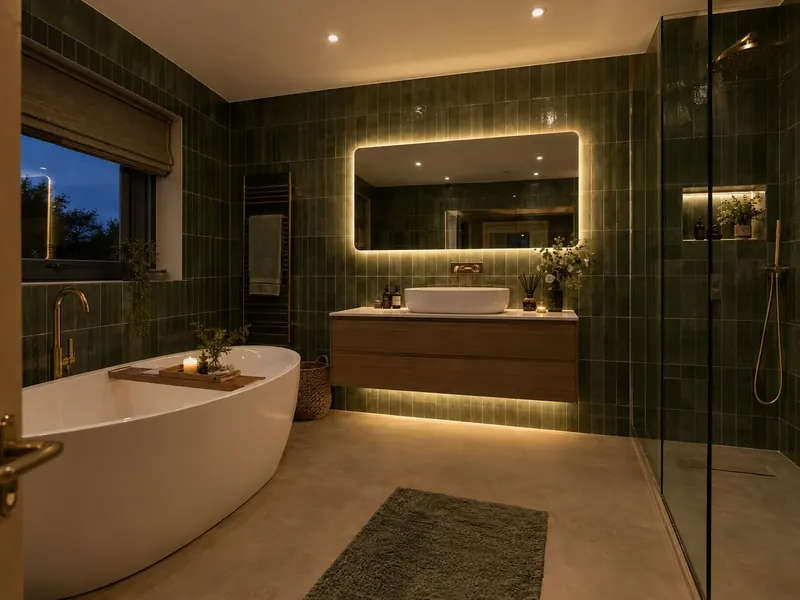
Bathroom with IP-rated downlights and an illuminated mirror

A single ceiling light in the middle of a bathroom puts your face in shadow at the mirror and leaves the shower dim. Better bathroom lighting works in layers: downlights for general light and over the shower, a light at the mirror for shaving and make-up, and perhaps a low glow from a niche or plinth for night-time. Each fitting has to suit the spot where it sits, because water and electricity meet in this room more than any other.

Lighting is installed by a qualified electrician, then tested and certified. Essential lighting with IP-rated downlights, switching and RCD protection typically costs £300 to £600 including VAT. A layered scheme adding a mirror light and a shaver socket costs £600 to £1,200, and feature lighting with niche strips, an illuminated cabinet, dimming or sensors £1,000 to £2,000. Most jobs take half a day to two days.

What does new bathroom lighting with us include?

  • A lighting plan: number and position of downlights, mirror lighting, switches and any shaver socket
  • IP-rated fittings chosen for each zone, with IP65 downlights over the bath or shower
  • Fire-rated downlights or fire hoods where the ceiling has to keep its fire resistance
  • Cable runs to each fitting, from the loft above or through the ceiling
  • A ceiling pull-cord or a switch outside the room, with separate switching for mirror and feature lights
  • A shaver supply unit where wanted, positioned away from direct spray
  • RCD protection on the lighting circuit, checked at the consumer unit and added where it is missing
  • Testing and an electrical certificate for the work on completion

How much does new bathroom lighting cost?

Our UK guide range is £350–£1,200 including VAT. Typical prices by kind of job:

Layered

£600–£1,200
  • Downlights plus mirror or vanity light
  • Shaver socket
  • Separate switching

Feature

£1,000–£2,000
  • Niche and plinth LED strips
  • Illuminated mirror cabinet
  • Dimming and sensors

National guide prices including VAT, reviewed October 2026. London is typically about 25% higher and the North East, Wales and Northern Ireland around 7–12% lower. Your written quote after the survey is the price that counts.

What do you need to decide?

Downlight positions

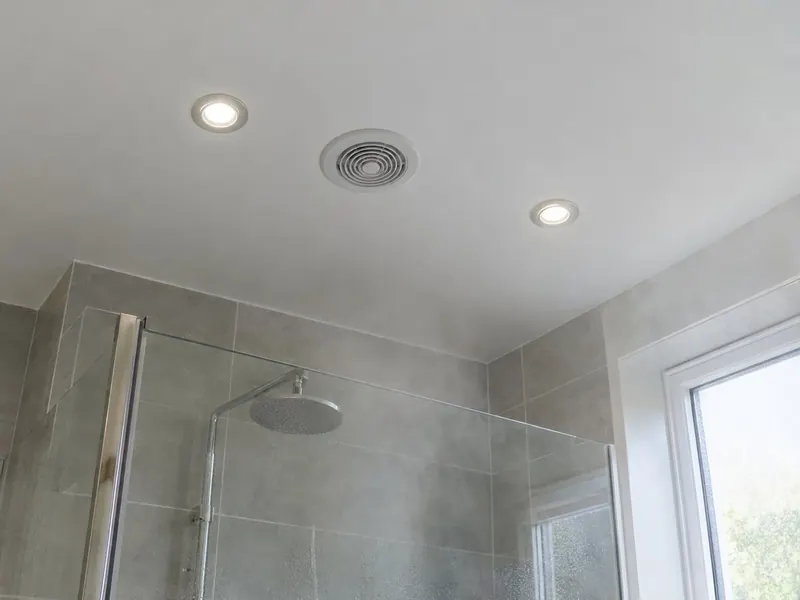
Evenly spaced downlights give flat, general light. Placing one over the shower and one over the basin puts the light where you actually use it.

Colour temperature

Warm white, around 3000 K, feels softer; cool white, around 4000 K, is crisper for shaving and make-up. Mixing the two in one room looks uneven.

Mirror lighting

An illuminated mirror or mirror cabinet lights the face from the front, which a ceiling light cannot do. Many include a demister pad and a shaver socket.

Feature lighting

LED strips in niches, under a wall-hung vanity or along a plinth give enough light for night-time without full glare.

Switching

A pull-cord inside, a switch outside the door or a motion sensor. Dimmers need LED fittings that are compatible with them.

Integrated or replaceable LED

Integrated LED downlights are slimmer and fully sealed. Fittings with replaceable lamps let you change brightness or colour later.
How does the job run?

  1. Plan

    We agree positions for each light, switch and socket, measured against your actual bath and shower positions.

  2. First fix

    Cables go in before boarding or through the existing ceiling, and the circuit's RCD protection is checked.

  3. Cut in

    Downlight holes are cut, fire hoods fitted where needed, and the mirror supply set at the right height behind the tiles.

  4. Second fix

    Fittings, switches and the mirror are connected once tiling and decorating are finished.

  5. Test and certify

    The circuit is tested and you get the certificate; in England and Wales the work is also notified to building control.

Who is it right for?

  • Bathrooms with a single central light that leaves the mirror and shower in shadow
  • Refits where the ceiling is being replaced or opened up anyway
  • Windowless rooms that rely on good artificial light at all times
  • Anyone adding an illuminated mirror, a shaver socket or low night-time lighting

What should you watch out for?

  • Check each fitting's IP rating against the zone it will sit in, not just against bathrooms in general
  • Ordinary sockets are not allowed within 3 m of zone 1; a shaver supply unit is the exception
  • Cutting downlights into a ceiling below a loft can break the insulation and fire protection; ask what goes above each light
  • Make sure you get a certificate for the work and, for notifiable work in England or Wales, confirmation it has been notified

What rules apply to new bathroom lighting?

BS 7671 sets the rules for bathroom electrics across the UK. Every circuit in a room with a bath or shower needs 30 mA RCD protection. Zone 0 is inside the bath or shower tray and needs IPX7 fittings; zone 1 is above it up to 2.25 m and needs at least IPX4, or IPX5 where water jets are used; zone 2 extends 0.6 m out from zone 1, where IPX4 is recommended. Sockets other than shaver supply units must be at least 3 m from the zone 1 boundary.

England

In England, Part P makes a new circuit, a consumer unit replacement and any addition or alteration to circuits in a room with a bath or shower notifiable. The work must be done by an electrician registered with a competent person scheme or notified to building control. Replacing a light fitting like for like is not usually notifiable, but it still has to meet BS 7671.

Wales

Wales has its own Part P with a wider notifiable list than England, so more bathroom lighting work has to be notified. A registered electrician notifies it and gives you a certificate.

Scotland

Scotland has no Part P. Bathroom lighting must meet the building standards and BS 7671, including RCD protection and the zone rules, and small like-for-like work does not normally need a building warrant.

Northern Ireland

Northern Ireland has no Part P. Lighting work should follow BS 7671 as good practice, with the circuit tested and a certificate issued.

FAQ

Bathroom lighting: your questions answered

What IP rating do bathroom lights need?

It depends on the zone. Lights inside the bath or shower tray (zone 0) need IPX7; above the bath or shower up to 2.25 m (zone 1) they need at least IPX4, or IPX5 where water jets are used; within 0.6 m of that (zone 2) IPX4 is recommended. Many electricians fit IP65 downlights over a shower whatever the ceiling height. See our bathroom zones guide.

How much does it cost to fit bathroom downlights?

Essential bathroom lighting, with IP-rated LED downlights, switching and RCD protection, tested and certified, typically costs £300 to £600 including VAT. Adding a mirror or vanity light and a shaver socket brings it to £600 to £1,200. The number of lights and how easily the ceiling can be reached make the biggest difference.

Do I need an electrician to change a bathroom light?

Swapping a fitting like for like is not usually notifiable, but it still has to meet the zone and IP rules. Anything new, such as an extra light, a moved switch or a new circuit, is notifiable in England and Wales and should be done by a registered electrician. Given the water risk, an electrician is the sensible choice for any bathroom lighting.

Can you have a normal plug socket in a bathroom?

Only if it is at least 3 m from the edge of zone 1, which rules it out in most UK bathrooms. The exception is a shaver supply unit, which has an isolating transformer and is designed for bathrooms. It should sit away from direct spray.

Where should the light switch go in a bathroom?

Usually outside the door, or inside as a ceiling pull-cord. Ordinary wall switches are kept out of the bathroom zones, and a pull-cord keeps the switch itself out of reach of wet hands.

What colour light is best for a bathroom?

A neutral or cool white, around 4000 K, gives clear light at the mirror for shaving and make-up. Warm white, around 3000 K, feels more relaxing for the room as a whole. Some illuminated mirrors let you switch between the two.

Do bathroom downlights need to be fire-rated?

Where the ceiling has to resist fire, for example between flats, under a converted loft or in a three-storey house, cutting a hole for a downlight breaks that protection, so a fire-rated downlight or a fire hood is used. In other ceilings it is not required, though fire-rated fittings are a common choice anyway.

Can I have an illuminated mirror in a bathroom?

Yes. Illuminated mirrors made for bathrooms carry an IP rating for the zone they sit in and connect to an RCD-protected supply, usually switched with the room lights or by a sensor on the mirror. The cable position is set before tiling so the connection is hidden behind the glass.

Ready for a bathroom that fits properly?

Book a free home survey. You get a measured layout and an itemised written quote before any work starts.