
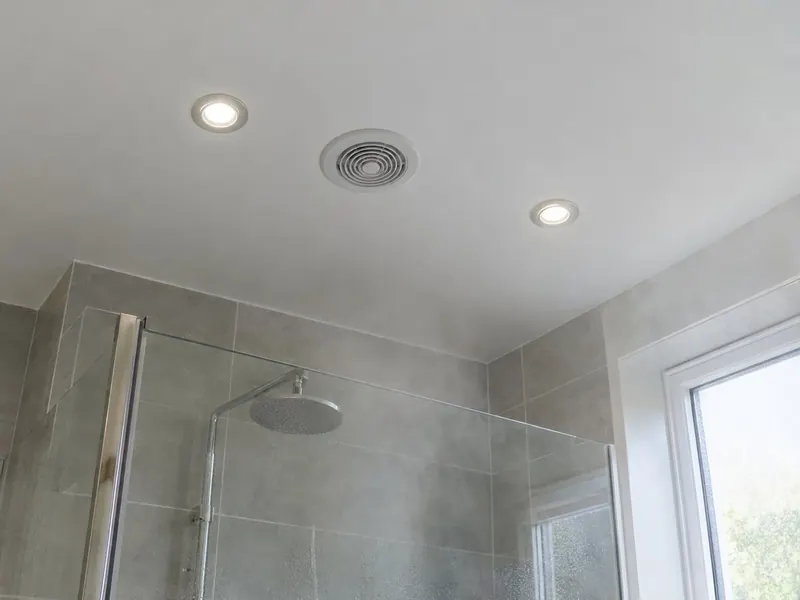
Do you legally need an extractor fan in a bathroom?
You must fit mechanical extraction when a new bathroom is formed, and on a refit you should not replace an existing fan with a less effective one; for an existing bathroom without a fan, adding one is not always required but is strongly advisable.
In England, ventilation is covered by Approved Document F of the Building Regulations. Creating a new bathroom, such as a new en-suite or a bathroom in a loft conversion, is building work, and the room needs extract ventilation at the required rate. An openable window alone is not enough for a new bathroom.
A like-for-like refit does not usually bring in new ventilation requirements. The principle is that the work should not make the ventilation worse, so swapping a fan for a weaker one, or taking it out, should be avoided.
Even where it is not required, a good fan is the simplest protection a bathroom has. Without one, moisture from every shower settles on the ceiling, window frames and grout, and mould follows. A new extractor fan, supplied and fitted, typically costs £250–£450 including VAT.
What extraction rate does a bathroom fan need?
In England, a bathroom extractor fan must extract at least 15 litres per second if it runs intermittently, or 8 litres per second if it runs continuously. The other UK nations use similar rates.
| Nation | Guidance | Bathroom extract |
|---|---|---|
| England | Approved Document F | 15 l/s intermittent, or 8 l/s continuous |
| Wales | Part F (Wales) | Similar rates, set in the Welsh guidance |
| Scotland | Building standards Technical Handbook | 15 l/s intermittent |
| Northern Ireland | Technical Booklet K | Rates set in the booklet; building control confirms |
Fan packaging often shows m³/h rather than l/s. To convert, multiply l/s by 3.6: 15 l/s is 54 m³/h and 8 l/s is about 29 m³/h.
The figure on the box is usually measured with little or no ducting attached. Real airflow drops with every metre of duct and every bend, and the outside grille adds more resistance. So choose a fan with a comfortable margin above 15 l/s, especially with a long duct run, and keep the duct as short and straight as you can.
Should you choose a timer or a humidistat fan?
Choose a timer fan for a bathroom with a window that is used at predictable times, a humidistat fan for a room that steams up at odd hours, and a continuous fan for a windowless room or a flat.
Timer (overrun) fans
The fan starts with the light and keeps running for a set time after it is switched off. In a room with no openable window, Approved Document F asks for a 15-minute overrun. Timer fans are simple and reliable, but they do nothing if the light stays off.
Humidistat fans
A sensor switches the fan on when humidity rises and off when the air dries. It works without anyone remembering, which suits teenagers and en-suites. In humid summer weather it can run more than needed, but most have an adjustable setting.
Continuous fans
A low-energy fan runs all the time at a quiet trickle rate and boosts when humidity rises or the light goes on. It suits windowless bathrooms and en-suites, where steady extraction stops condensation building up. Continuous extract typically costs £450–£900 supplied and fitted.
Many fans combine a timer and a humidistat, which covers most homes well.
Where should a bathroom extractor fan go?
A bathroom extractor fan should go high on the wall or in the ceiling, close to the shower or bath and as far as possible from the door, so fresh air is drawn across the whole room.
- Near the source. Steam rises from the shower and bath, so the fan should sit above or close to them.
- Opposite the air inlet. Replacement air usually comes in under the door. A fan right beside the door just pulls that air straight back out.
- A gap under the door. Approved Document F expects a gap of about 10 mm under internal doors so air can get in. Without it, the fan struggles.
- Clear of obstructions. Keep it away from cupboards, beams and the tops of shower screens that block the airflow.
- The right rating for the zone. A fan in zone 1, above the bath or shower, needs at least IPX4. Many installers use an extra-low voltage fan there, run from a transformer outside the zones.
Ceiling fans are usually easiest to duct through the loft. Wall fans suit rooms on an outside wall, where the duct can be very short. Our guide to bathroom zones and electrics explains the zone rules in full.
What size of fan and ducting do you need?
Most bathrooms use a 100 mm fan with 100 mm ducting, which is enough for a short, straight run to an outside wall or through the loft; longer runs or larger rooms suit a 125 mm or 150 mm system or an inline fan.
- Match or increase the duct size. Never reduce the duct below the fan's outlet size, because it chokes the airflow.
- Prefer rigid or semi-rigid duct. Smooth duct moves more air than ribbed flexible hose, which should be kept short and pulled taut.
- Keep bends to a minimum. Each bend cuts the airflow. Two long sweeps are better than several tight elbows.
- Keep it short. The shorter the run, the closer the fan gets to its stated performance.
Noise matters too. A fan that is too small for its duct runs flat out and sounds loud. An inline fan mounted in the loft, with only a grille in the ceiling, is much quieter in the room and copes with longer runs. Inline fans typically cost £400–£700 supplied and fitted, against £250–£450 for a standard extractor fan.
How should the ducting run to the outside?
Ducting must always end outside, through a wall grille, a soffit vent or a roof vent, and never just into the loft space, where the moist air would condense on the timbers and cause damp and mould.
- Insulate in cold spaces. Duct running through a cold loft should be insulated, or warm air condenses inside it and water runs back to the fan.
- Fall away from the fan. Where possible, slope the duct slightly down towards the outside, or fit a condensation trap on vertical runs.
- Seal every joint. Use proper connectors and tape so moist air cannot leak into the loft.
- Fit a backdraught shutter. It stops cold air and draughts coming back in when the fan is off.
- Use a proper outlet. A wall grille or soffit vent with a mesh keeps out birds and insects.
Water dripping from the fan, black marks around the grille or mould on the loft timbers above the bathroom are signs the ducting is wrong. Putting it right usually costs far less than the damage it causes. In a flat, check the lease before making a new hole in an outside wall, as freeholder consent is often needed.
Who should fit a bathroom extractor fan?
A bathroom extractor fan should be fitted by a qualified electrician, because wiring it is an addition to a circuit in a room with a bath or shower, which is notifiable work in England.
The fan needs a supply with 30 mA RCD protection, an isolator so it can be serviced safely, and a connection to the light switch or a permanent live for the overrun and humidistat. The duct and outside vent are building work, and drilling through an outside wall or roof needs care around cables, pipes and the damp-proof course.
On our jobs, the fan is chosen to meet the extract rate, ducted to the outside and wired by a qualified electrician who tests and certifies the work. A standard fan typically adds £250–£450 to a bathroom, and continuous extract £450–£900. See extractor fans and ventilation for the options, or price the whole room on the quote page.
Questions about this guide
Can a bathroom extractor fan vent into the loft?
No. The duct must carry the air all the way outside through a wall, soffit or roof vent. Venting into the loft puts warm, moist air onto cold timbers, which leads to condensation, damp and mould.
How long should a bathroom fan run after a shower?
In a room without an openable window, set the overrun to at least 15 minutes, as Approved Document F expects. In any bathroom, keep it running until the mirror and walls are clear. A humidistat fan stops by itself once the air has dried.
Is a window enough ventilation for a bathroom?
For a new bathroom, no: the regulations expect mechanical extraction as well. In an existing bathroom a window helps, but few people open it in winter, so a fan is still the reliable way to remove steam.
Why is my extractor fan dripping water?
Usually because warm, moist air is condensing inside the duct. The fix is to insulate the duct where it runs through a cold loft, slope it towards the outside or fit a condensation trap, and make sure it ends at an outside vent.
Guide prices include VAT and were reviewed in October 2026. Rules summarised here are general information, not legal advice; we check what applies to your home at the survey.
Add Fitted Bathrooms as a preferred source on Google