
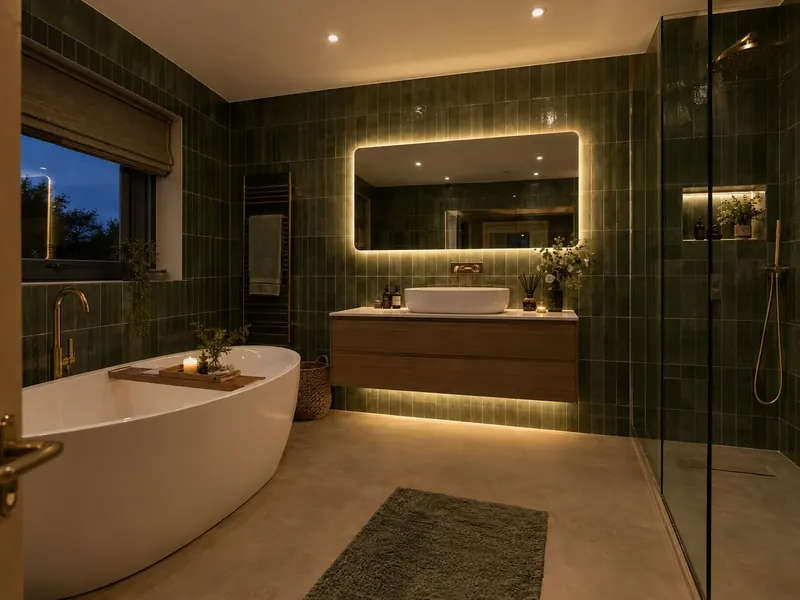
What are bathroom zones?
Bathroom zones are areas defined in BS 7671, the UK wiring regulations, that set how well electrical equipment must resist water depending on how close it is to the bath or shower. The closer to the water, the stricter the rules.
- Zone 0 is the inside of the bath or shower tray, the space that can hold water.
- Zone 1 is the space directly above the bath or tray, up to 2.25 m from the floor, or to the height of a fixed shower head if that is higher. For a shower with no tray, it extends 1.2 m out from the fixed water outlet.
- Zone 2 runs 0.6 m out horizontally from the edge of zone 1, up to the same height.
- Outside the zones is the rest of the room.
The zones are measured from the finished fittings, so they move when you move the bath or shower. That is why the electrical plan should be drawn after the layout is fixed. The space under a bath counts as zone 1 unless it can only be reached with a tool, for example behind a screwed-on bath panel.
What IP rating do you need in each bathroom zone?
Fittings in zone 0 need at least IPX7, fittings in zone 1 need at least IPX4 (IPX5 where water jets are used, such as for cleaning), and IPX4 is the usual minimum in zone 2. Outside the zones there is no set water rating, though IP44 fittings are a sensible choice anywhere steam collects.
| Zone | Where it is | Minimum rating | Typical equipment |
|---|---|---|---|
| Zone 0 | Inside the bath or shower tray | IPX7 | Only equipment made for immersion, usually extra-low voltage |
| Zone 1 | Above the bath or tray, up to 2.25 m | IPX4, or IPX5 with water jets | Shower units, sealed downlights, suitable extractor fans |
| Zone 2 | 0.6 m beyond zone 1 | IPX4 | Downlights, extractor fans, a shaver supply unit away from direct spray |
| Outside the zones | The rest of the room | No set rating | Switches, fused spurs for heating |
An IP code has two digits. The first covers solid objects such as dust and fingers; the second covers water. An X means that part was not tested. IPX4 resists splashing from any direction, IPX5 resists low-pressure jets and IPX7 survives temporary immersion. So IP44 and IP65 fittings both meet an IPX4 requirement.
Why does every bathroom circuit need an RCD?
Every circuit in a room with a bath or shower needs 30 mA RCD protection, because an RCD cuts the power in a fraction of a second if current leaks to earth, for example through water or a person, and that is far more dangerous when skin is wet.
The rule covers the lighting, the extractor fan, the shower, the heated towel rail, the underfloor heating and anything else that serves the room. A modern consumer unit usually has RCD protection on every circuit, but older boards often protect only the sockets, leaving the lighting circuit unprotected.
If your board does not protect the bathroom circuits, the electrician will suggest a fix. That can be an RCBO, a combined circuit breaker and RCD, on the circuit concerned, or a new consumer unit. Replacing a consumer unit is notifiable work in England and Wales.
When every bathroom circuit has RCD protection and the main earthing and bonding are correct, the regulations allow supplementary bonding in the bathroom to be left out. The electrician checks this on site. You can test your RCDs yourself by pressing the test button on the consumer unit; each one should trip straight away.
Where can sockets and switches go in a bathroom?
In a UK bathroom, ordinary sockets must be at least 3 m from the edge of zone 1, so most bathrooms are too small for one. The exception is a shaver supply unit, the two-pin socket for shavers and electric toothbrushes, which can go closer as long as it is out of direct spray.
Switches follow similar logic. A standard wall light switch goes outside the zones, often outside the room by the door. Inside the room, a ceiling pull-cord switch is the normal answer, because the cord is insulated and the switch is out of reach of water.
- Electric shower: needs a double-pole isolating switch, usually a ceiling pull-cord, so it can be turned off fully.
- Extractor fan: usually has an isolator outside the zones, so it can be serviced safely.
- Heated towel rail or underfloor heating: fed from a fused spur placed outside the zones, often outside the room.
- Mirror lights and cabinets: must suit the zone they sit in.
Plan these positions with the layout, so the cables run where they are needed before the walls are boarded and tiled.
Is bathroom electrical work notifiable under Part P?
In England, most bathroom electrical work is notifiable under Part P of the Building Regulations, and the rules are different in Wales, Scotland and Northern Ireland.
England
Notifiable work means a new circuit, a consumer unit replacement, or any addition or alteration to circuits in a room containing a bath or shower. It must be done by an electrician registered with a competent person scheme, who self-certifies it, or notified to building control before work starts.
Wales
Wales has its own Part P, with a wider list of notifiable work. The same two routes apply.
Scotland
There is no Part P. Work must meet the building standards and BS 7671. Small like-for-like work does not normally need a building warrant, but forming a new bathroom, altering drainage or structural work may.
Northern Ireland
There is no Part P. BS 7671 is followed as good practice, and building control deals with drainage, structure and ventilation.
Electric showers usually need their own circuit, often 40–45 A for an 8.5–10.5 kW unit, so a new one is notifiable in England and Wales. See shower installation for what that involves.
What bathroom electrics can you do yourself?
Very little. In England you can legally swap a light fitting or switch like for like on an existing circuit without notifying anyone, but anything that adds to or alters a bathroom circuit is notifiable, and all work must still meet BS 7671.
Even where the law allows it, a bathroom is a poor place to learn electrics. Water, steam and metal pipework all raise the risk, and a mistake may not show until someone is hurt. Fittings must have the right IP rating for their zone, and every connection must be made and sealed properly.
Leave these to a qualified electrician:
- New lights, downlights or a new extractor fan
- An electric shower, or a change of shower power
- Electric underfloor heating or an electric towel rail
- Moving any switch, spur or fitting
- Anything involving the consumer unit
The safe jobs for you are the ones that need no tools near live parts: choosing IP-rated fittings, testing RCDs with the test button and keeping the fan grille clean. On our jobs, electrical work is carried out by a qualified electrician, then tested and certified. IP-rated LED downlights with RCD protection typically cost £300–£600; see bathroom lighting for more.
What paperwork should you get after bathroom electrical work?
You should get an electrical certificate for the work and, in England and Wales, proof that notifiable work has been registered with building control.
- Electrical Installation Certificate: for a new circuit, such as an electric shower or underfloor heating.
- Minor Electrical Installation Works Certificate: for additions or alterations to an existing circuit, such as new lights or a new fan.
- Building regulations compliance certificate: issued after a registered electrician notifies the work through their competent person scheme. If building control handled it instead, they issue a completion certificate.
Keep these with your property documents. A buyer's solicitor will usually ask for them when you sell, and missing paperwork for notifiable work can delay a sale.
Check that the certificate shows the right address, describes the work done and includes the RCD test results. If the bathroom is also getting a new extractor fan, read our guide to extractor fan rules to make sure it meets the ventilation rates too.
Questions about this guide
Can you have a plug socket in a bathroom in the UK?
Only if it is at least 3 m from the edge of zone 1, which rules it out in most homes. A shaver supply unit, the two-pin socket for shavers and toothbrushes, is allowed closer, as long as it is out of direct spray.
Do bathroom lights have to be IP-rated?
Lights in zones 1 and 2 must be at least IPX4, and above a shower many electricians choose IP65. Outside the zones there is no set rating, but IP44 fittings cope better with steam.
Does an electric shower need its own circuit?
Yes, in almost every case. Electric showers draw a lot of current, often 40–45 A for an 8.5–10.5 kW unit, so they need a dedicated circuit with RCD protection and a double-pole isolating switch. A new circuit is notifiable in England and Wales.
Do I need an electrician to change a bathroom light?
A like-for-like swap on an existing circuit is not notifiable in England, but the new fitting must suit its zone and be connected and sealed correctly. Adding or moving a light alters the circuit and is notifiable, so use a qualified electrician.
Guide prices include VAT and were reviewed in October 2026. Rules summarised here are general information, not legal advice; we check what applies to your home at the survey.
Add Fitted Bathrooms as a preferred source on Google