
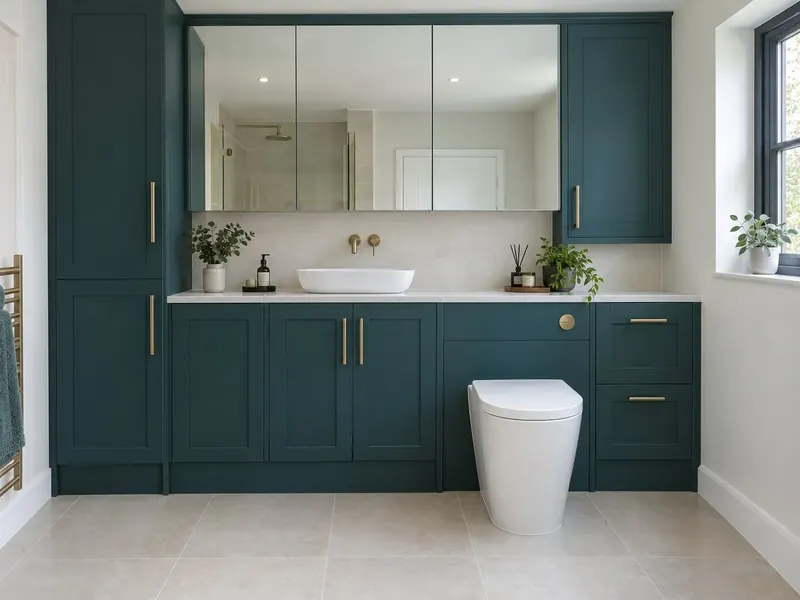
What is the difference between fitted and freestanding bathroom furniture?
Fitted bathroom furniture is a continuous run of units built to the width of your wall, with the basin, WC cistern and pipework hidden inside and a single worktop across the top. Freestanding furniture is a set of separate pieces, such as a vanity unit on legs, a pedestal basin, a close-coupled WC and a standalone cabinet, each of which stands on its own.
A fitted run is planned around the room. Fillers are cut to meet the walls, so there are no gaps for dust and the pipework disappears behind panels. It looks built-in, much like a fitted kitchen.
Freestanding pieces are chosen one at a time. They can be moved, replaced individually or taken with you, and they sit comfortably in period rooms where walls are rarely straight. The pipework is more visible, although a basin on a vanity unit still hides the trap and tails.
How do fitted and freestanding furniture compare?
Fitted furniture wins on storage and a clean finish, while freestanding wins on up-front cost and flexibility. The table sets out the main differences.
| Factor | Fitted | Freestanding |
|---|---|---|
| Storage | Uses the full width of the wall, often with tall units | Limited to the pieces you choose |
| Pipework | Hidden behind panels, including the cistern | Partly visible, especially around the WC |
| Cleaning | One worktop, few gaps, plinth to the floor | More edges, legs and gaps to clean around |
| Guide cost | Compact run £1,200–£2,500; full run £2,500–£5,000 | Vanity unit supplied and fitted £400–£1,000 |
| Fitting time | 1–3 working days for the furniture | Half a day to a day per unit |
| Flexibility | Planned once; changes mean new panels | Pieces can be swapped or moved |
| Suits | Modern homes, family bathrooms, en-suites | Period rooms, uneven walls, tight budgets |
Most people decide on two questions: how much storage the room needs, and how long you plan to stay in the home.
Which gives you more storage?
Fitted furniture gives you more storage in the same room, because it uses space that freestanding pieces leave empty.
In a fitted run, the void around the concealed cistern becomes a cupboard or a shelf. The worktop carries on over the WC, giving you a surface for toiletries. Tall units can rise from floor to ceiling at one end, and drawers under the basin hold far more than a single shelf. Mirror cabinets can be built in above.
Freestanding pieces leave gaps: behind the pedestal, beside the toilet and between units. You can fill some of that with a tall cabinet or a shelf over the cistern, but the space stays broken up.
If storage is your main problem, especially in a family bathroom where several people keep their things, a fitted run is usually the stronger choice. If you mainly need a basin and somewhere for a few bottles, a good vanity unit and a mirror cabinet may be all you need. Our fitted bathroom furniture page shows typical layouts and finishes.
How much does fitted bathroom furniture cost compared with freestanding?
Fitted bathroom furniture typically costs £1,500–£6,000 supplied and fitted, while a single freestanding or wall-hung vanity unit is usually £400–£1,000.
- Compact fitted run: £1,200–£2,500 for a vanity and WC unit with a concealed cistern, a laminate worktop and soft-close doors.
- Full fitted run: £2,500–£5,000, adding tall storage, a quartz-effect or solid-surface top and fillers scribed to the walls.
- Wall-to-wall: £4,500–£8,000 for floor-to-ceiling storage, mirror cabinets and lighting, made to suit awkward spaces.
- Vanity unit, supplied and fitted: £400–£1,000 including the basin, tap and waste.
- Double or bespoke vanity: £1,000–£2,500.
- Fitting a unit you have bought: £150–£350.
Fitted furniture also changes the WC. A concealed cistern pairs with a back-to-wall pan, which usually costs a little more than a close-coupled toilet but is easier to clean around. These prices include VAT and are national guide ranges; your quote will reflect your room.
Is fitted furniture easier to keep clean?
Yes, in most bathrooms fitted furniture is easier to keep clean, because it has fewer edges, legs and gaps where dust and hair collect.
A fitted run sits on a plinth or hangs from the wall, with a sealed worktop across the top. There is no gap behind the toilet, no pedestal to wipe around and no pipework to dust. A one-piece moulded basin and top has no joints at all, and a back-to-wall WC pan has a smooth profile with nothing behind it.
Freestanding pieces need more work. You clean around legs, behind pedestals and between each unit and the wall. A single wall-hung vanity is a halfway house: it is not part of a fitted run, but it leaves the floor clear and is easy to mop underneath.
Whichever you choose, the worktop matters. Laminate is the budget option and needs well-sealed edges. Quartz-effect and solid-surface tops resist water and stains better. The silicone where the worktop meets the wall should be replaced as soon as it discolours or starts to lift.
Which works better in a small or awkward room?
It depends on the room: fitted furniture makes the most of alcoves, boxing and sloping ceilings, while slim freestanding or wall-hung pieces suit very small rooms where every bit of floor counts.
Fitted runs are made to measure. They can wrap round a soil pipe, fill a chimney-breast alcove or step down under the eaves of a loft bathroom. Fillers are scribed to walls that are out of square, so the run looks straight even when the room is not.
In a very small bathroom or cloakroom, depth matters more than width. A full-depth fitted run can feel bulky in a narrow room. Slimline vanity units, short-projection basins and a wall-hung WC show more floor and make the space feel bigger. Our guide to planning a small bathroom covers the dimensions and clearances to work to.
Period homes are a special case. A freestanding washstand or a pedestal basin can suit the character of the room better than a modern run, and it avoids cutting into original features.
What should you check before choosing fitted furniture?
Before you choose fitted furniture, check what the units are made of, how you will reach the cistern, and whether the room is ventilated well enough to protect them.
- Carcass material. Look for moisture-resistant board and sealed edges. Standard chipboard swells if water gets in.
- Access to the cistern. Concealed cisterns are serviced through the flush plate opening or a removable panel. Make sure the design allows for it.
- Worktop joints. Fewer joints mean fewer places for water to sit.
- Plinths and feet. Adjustable legs behind the plinth cope with uneven floors.
- Ventilation. A working extractor fan protects the furniture from damp as well as the walls.
- Lead time. Made-to-measure runs take longer to arrive, so order early.
You can also mix the two approaches. A fitted vanity and WC run with a freestanding bath is a popular combination, as is a fitted run on one wall with a single tall cabinet elsewhere in the room.
Questions about this guide
Is fitted bathroom furniture worth the extra cost?
It is worth it if storage and a clean, built-in look matter to you and you plan to stay in the home for a while. If you mainly need a basin and a little storage, a good vanity unit and a mirror cabinet cost less and do the job.
Can fitted bathroom furniture go on uneven walls?
Yes. Fitted runs use fillers that are scribed, or cut, to follow the line of the wall, and adjustable legs behind the plinth deal with uneven floors. The run looks straight even when the walls are not.
How do you repair a concealed cistern behind fitted furniture?
Most concealed cisterns are serviced through the opening behind the flush plate, so the fill valve and flush mechanism can be reached without taking the furniture apart. A removable panel in the unit gives extra access where needed.
Is a wall-hung vanity unit fitted or freestanding?
A wall-hung vanity unit on its own is usually treated as a standalone piece, because it is not part of a continuous run. Wall-hung units can also form part of a fitted design, where several units are fixed along one wall under a shared worktop.
Guide prices include VAT and were reviewed in October 2026. Rules summarised here are general information, not legal advice; we check what applies to your home at the survey.
Add Fitted Bathrooms as a preferred source on Google