
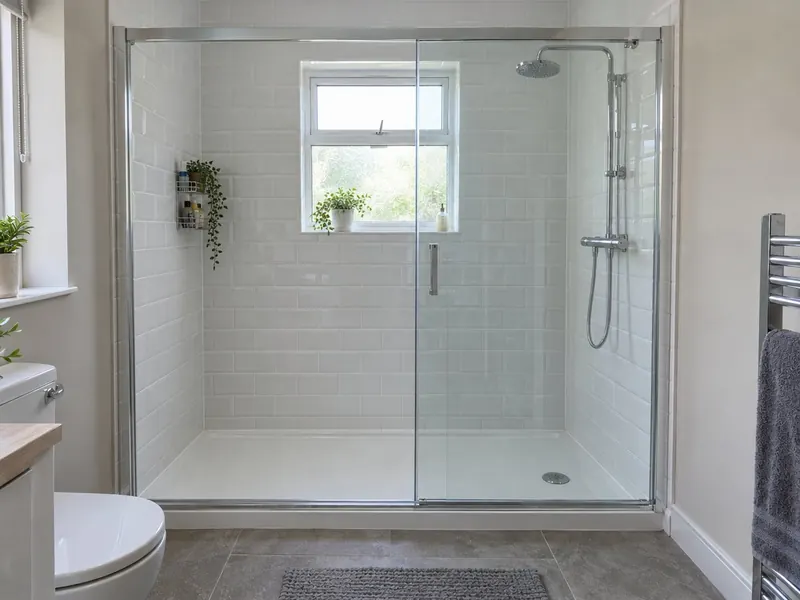
Is it a good idea to replace your bath with a shower?
Replacing a bath with a shower is a good idea when nobody in the home uses the bath, when getting in and out of it has become hard, or when the space would work better as a large, comfortable shower. It is a poor idea if it leaves a family home with no bath at all.
Plenty of baths are used as nothing more than a place to stand under an over-bath shower. In that case a walk-in shower in the same space is easier to step into, easier to clean and often feels bigger, because a low tray and a single glass panel take up less visual room than a bath and screen.
The opposite is also true. Young children are much easier to wash in a bath, some people rely on a soak to ease aches or to relax, and a bath is handy for washing pets. Before you decide, think about who will use the room over the next five to ten years, not just today.
Does removing the bath affect the value of your home?
Removing the only bath can make a family home less appealing to some buyers, while swapping a second bath for a shower rarely matters.
Buyers with young children often look for a bath, so a three or four-bedroom house with only a shower may narrow the field when you sell. There is no reliable figure for how much it changes the price; it depends on the area and the buyers your home attracts. If you are unsure, ask a local estate agent what buyers in your street expect.
The picture is different elsewhere. In a one or two-bedroom flat, a smart walk-in shower can be a selling point. If the home keeps a bath in the main bathroom, replacing the bath in an en-suite or second bathroom with a large shower is usually a safe change.
A sensible rule is to keep at least one bath in a family-sized home. If you plan to stay for many years, how you live in the home should come first.
What suits a family with young children?
A bath with a good shower over it usually suits a family with young children, because it does both jobs in one space.
Bathing a baby or toddler is far easier in a bath than in a shower, and older children can shower over the bath once they are ready. A fixed glass bath screen keeps the floor drier than a curtain. A thermostatic shower valve protects against sudden temperature changes when someone runs a tap or flushes elsewhere in the house.
Hot water safety matters too. In England, a new bath in a new home must be limited to 48 °C at the outlet, usually with a thermostatic mixing valve. That rule does not apply to a replacement bath in an existing home, but fitting one is sensible when children use the room.
If the room is tight, a shower bath is a good compromise. It is wider at the shower end, often P or L-shaped, giving more standing space without losing the bath. Our family bathrooms page shows typical layouts.
How much space do you need for a bath, a shower or both?
A standard bath needs a wall about 1,700 mm long and 700 mm deep, a comfortable shower needs at least 900 × 900 mm or 1,200 × 800 mm, and fitting both separately usually needs a larger room of around 6 m² or more.
- Bath: 1,700 × 700 mm is standard. Compact baths of 1,500 or 1,600 mm suit short walls.
- Shower tray: 800 × 800 mm is the practical minimum, but 900 × 900 mm or a 1,200 × 800 mm rectangle feels much better.
- Walk-in shower in a bath space: a 1,700 × 700 mm or 1,700 × 800 mm tray fits where the bath was and gives a long, open shower with a single panel.
- Room to dry off: leave clear floor beside the bath or shower to step out and towel down.
Swapping a bath for a full-length tray is the simplest conversion, because the waste and supply are already at that end of the room. If you want both a bath and a separate shower, the survey will show whether the room allows it without squeezing the WC and basin.
Does a shower use less water than a bath?
Usually, yes: a short shower uses less water, and less energy to heat it, than a full bath, but a long shower on a high-flow mixer or power shower can use as much or more.
The type of shower makes the biggest difference. An electric shower heats cold mains water as it flows, so its flow is fairly gentle. A mixer shower on a combi boiler or an unvented cylinder can deliver much more water per minute, and a pumped power shower on a gravity system more again. Time spent in the shower matters just as much.
If you are on a water meter or want to cut energy bills, a few things help:
- Choose a thermostatic shower so you reach the right temperature quickly.
- Fit a water-efficient shower head that keeps a good spray at a lower flow.
- Keep the bath for occasional soaks rather than every day.
Check your hot water system too. A combi boiler can be slow to fill a large bath, and a pump must never be connected directly to the mains supply: shower pumps are only for gravity systems with a cold water tank.
How much does it cost to swap a bath for a shower?
A bath-to-shower conversion typically costs £2,000–£5,000 supplied and fitted, including VAT, and takes 2–6 working days.
- Tray and enclosure: £2,000–£4,000. The bath comes out and a tray goes in its place, with a glass enclosure or walk-in panel, a thermostatic shower and re-tiling.
- Walk-in shower: £3,000–£5,500, with a large tray, a frameless screen, a concealed valve and full-height tiling.
- Level-access floor: £4,500–£8,000, with a floor former, tanking, a linear drain and options for grab rails and a seat.
If you decide to keep a bath, the costs are lower. A like-for-like bath replacement is £900–£1,800, a shower bath with a screen is £1,400–£2,500, and a new thermostatic shower over an existing bath is £800–£1,800.
Where the change is needed because of a disability, a Disabled Facilities Grant may help, and the work can be zero-rated for VAT. See our bath to shower conversions page for what each option includes.
Is there a middle ground between a bath and a shower?
Yes. A shower bath, a bath with a good shower over it, or a separate bath and shower in a larger room all let you keep a bath without giving up a proper shower.
- Shower bath: wider at one end, giving more standing room, with a fixed screen that follows the curve.
- Bath with shower over: the simplest answer. A thermostatic bar or concealed valve, a riser rail and a glass screen make it work well.
- Separate bath and shower: the most comfortable choice if the room is large enough.
- Bath in the main bathroom, shower in the en-suite: keeps the home appealing to families and gives everyday convenience.
Some people choose a walk-in or low-level bath with a door instead. These are designed for people who still want to bathe but find stepping over a bath side difficult. For step-free shower options, see wet room or walk-in shower.
Questions about this guide
Does a house need a bath to sell?
No. There is no rule that a home must have a bath. Some buyers, especially families with young children, look for one, so keeping at least one bath in a family-sized house is the safer choice if you plan to sell.
Can I get help paying for a bath-to-shower conversion?
If the change is needed because of a disability, you may qualify for a Disabled Facilities Grant: up to £30,000 in England, £36,000 in Wales and £25,000 in Northern Ireland through the Housing Executive. Scotland has a council Scheme of Assistance instead. Grants are means-tested and need approval before work starts.
How long does it take to replace a bath with a shower?
Most bath-to-shower conversions take 2–6 working days. A tray in the bath space is at the quicker end; a level-access floor takes longer, because the floor has to be built up and waterproofed before tiling.
Will a new shower work with my boiler?
Usually. A combi boiler or unvented cylinder can run a mixer shower at mains pressure. A low-pressure gravity system may need a shower pump, which is only allowed where there is a cold water tank. An electric shower works on almost any system but needs its own electrical circuit.
Guide prices include VAT and were reviewed in October 2026. Rules summarised here are general information, not legal advice; we check what applies to your home at the survey.
Add Fitted Bathrooms as a preferred source on Google