Free home survey & written quote · Fitted bathrooms across England, Wales, Scotland & Northern Ireland0800 088 6341
Fitted Bathrooms
Furniture, finishes & services

Bathroom extractor fans and ventilation

Bathroom ventilation is the extract that removes steam and moisture from a bathroom to the outside, usually through an extractor fan in the ceiling or wall, so that condensation does not lead to mould, peeling paint or damage to the room.

From £250 inc VAThalf a dayFree home survey
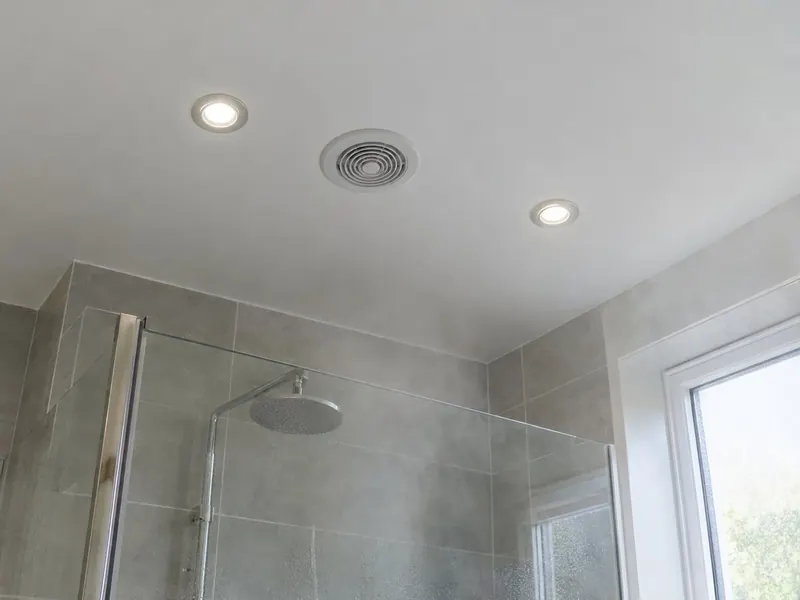
Bathroom extractor fan fitted in the ceiling

An opening window is not enough on its own in most bathrooms, especially in winter when nobody opens it. Moisture from a shower settles on the coldest surfaces first: the ceiling, the window reveal, the corner behind the WC. Over time that means black mould in the grout and silicone, flaking paint and swollen furniture. A fan that is sized and ducted properly, and keeps running long enough after each shower, stops most of it.

Supplying and fitting a standard extractor fan with a timer or humidistat, ducted outside and wired to regulations, typically costs £250 to £450 including VAT. A quieter inline fan in the loft with a ceiling grille costs £400 to £700, and a low-energy continuous extract fan that runs all the time and boosts on humidity £450 to £900. Most fans are fitted in half a day.

What does a bathroom extractor fan with us include?

  • A check of the room, any existing fan or vent, and the shortest route to the outside
  • A fan chosen to meet the bathroom extract rate: 15 l/s intermittent or 8 l/s continuous
  • Core-drilling through the wall, or ducting through the loft to a roof or soffit vent
  • Rigid or semi-rigid ducting kept short and straight, and insulated where it crosses a cold loft
  • A backdraught shutter and external grille, so cold air does not blow back in
  • Wiring by a qualified electrician, with an isolator outside the room and RCD protection
  • Run-on timer, humidistat or light-linked switching set up to suit how the room is used
  • Making good around the fan and checking that it extracts properly at the grille

How much does a bathroom extractor fan cost?

Our UK guide range is £250–£600 including VAT. Typical prices by kind of job:

Inline fan

£400–£700
  • Quiet fan in the loft void
  • Ducting to a roof or soffit vent
  • Grille in the ceiling

Continuous extract

£450–£900
  • Low-energy fan running all the time
  • Boost on humidity
  • Good for windowless rooms

National guide prices including VAT, reviewed October 2026. London is typically about 25% higher and the North East, Wales and Northern Ireland around 7–12% lower. Your written quote after the survey is the price that counts.

What do you need to decide?

Wall or ceiling

A wall fan on an outside wall is the simplest. A ceiling fan over the shower takes steam away at source but needs ducting through the loft.

Axial, centrifugal or inline

Axial fans suit short, straight runs; centrifugal fans cope better with longer ducts; inline fans sit in the loft and are the quietest in the room.

Timer or humidistat

A timer keeps the fan running after the light goes off. A humidistat starts it whenever moisture rises, which suits rooms where people forget.

Intermittent or continuous

An intermittent fan runs during and after use. A continuous fan runs quietly all the time at a low rate and boosts when humidity rises.

Replacement air

A fan needs air to replace what it removes, so leave a gap of around 10 mm under the door or fit a door grille. A sealed room starves the fan.

Noise

Compare the stated noise level in decibels. Inline fans and low-speed continuous fans are much quieter in the room than budget axial fans.
How does the job run?

  1. Survey

    We look at the room, any existing fan, the outside wall or loft route, and how the current fan is wired.

  2. Choose the fan

    The fan is picked to meet the extract rate through the duct length and bends it will actually have.

  3. Make the route

    The wall is cored or the duct is run through the loft to a vent, falling slightly towards the outside so condensation drains away.

  4. Wire and fix

    The electrician wires the fan with an isolator and the chosen controls, and the fan is fixed and sealed.

  5. Test and set

    We check the airflow at the grille, set the run-on time or humidity level, and make good around the fan.

Who is it right for?

  • Bathrooms and en-suites with mould on the ceiling, grout or silicone
  • Windowless bathrooms and shower rooms
  • Rooms where the existing fan is noisy, weak or stops the moment the light goes off
  • New bathrooms and en-suites, where extract ventilation is a building regulations requirement

What should you watch out for?

  • A fan only reaches its stated flow through a short, straight duct; long flexible runs with bends can cut it badly
  • Uninsulated ducts in a cold loft collect condensation that drips back into the room
  • Do not replace an existing fan with a less effective one; match or improve on the old extract rate
  • In a flat, check the lease before cutting a new vent through an outside wall

What rules apply to a bathroom extractor fan?

A bathroom needs extract ventilation when it is newly formed, and on a refit an existing fan should not be replaced with a less effective one. The fan and its wiring must meet BS 7671 for the zone it sits in, on a circuit with 30 mA RCD protection. In a flat, the lease often requires freeholder consent for a new extract vent, and in a listed building a new opening through an external wall can need listed building consent.

England

In England, Approved Document F sets bathroom extract at 15 l/s for an intermittent fan or 8 l/s for continuous extract. Wiring a new fan alters a circuit in a room with a bath or shower, so it is notifiable under Part P.

Wales

Wales has its own Part F with similar extract rates, and its own Part P, under which new fan wiring in a bathroom is notifiable.

Scotland

In Scotland, the Technical Handbook also uses 15 l/s extract for a bathroom. A replacement fan rarely needs a building warrant, but forming a new bathroom may.

Northern Ireland

In Northern Ireland, ventilation is covered by Technical Booklet K, and building control is involved where a new bathroom is formed. There is no Part P, but the fan should be wired, tested and certified to BS 7671.

FAQ

Extractor fans & ventilation: your questions answered

How much does it cost to fit a bathroom extractor fan?

Supplying and fitting a bathroom extractor fan with a timer or humidistat, ducted outside and wired to regulations, typically costs £250 to £450 including VAT. An inline fan in the loft costs £400 to £700, and continuous extract £450 to £900. Core-drilling a thick stone wall or a long duct route can add to the price.

What extraction rate does a bathroom fan need?

In England, Approved Document F asks for 15 litres per second from an intermittent bathroom fan, or 8 litres per second from a continuous one. Scotland's Technical Handbook also uses 15 l/s for a bathroom, Wales has similar rates in its own Part F, and Northern Ireland sets its rates in Technical Booklet K. Choose a fan that reaches the rate through your actual duct run, not just in open air. Our extractor fan rules guide explains more.

Is an extractor fan a legal requirement in a bathroom?

For a newly formed bathroom, yes: building regulations require extract ventilation. On a refit of an existing bathroom, the rules focus on not making ventilation worse, so an existing fan should not be swapped for a less effective one. In practice, almost every bathroom is better with a working fan.

Should a bathroom fan be on a timer or a humidistat?

A timer suits most bathrooms: the fan comes on with the light and runs on after it is switched off. A humidistat is better where people shower in daylight without the light on, or in rooms that stay damp, because it starts the fan whenever moisture rises. Many fans offer both.

Can an extractor fan go above a shower?

Yes, if it suits the zone. The space above a shower or bath, up to 2.25 m, is zone 1, which needs at least IPX4, or IPX5 where water jets are used. Many fans come in mains and low-voltage versions, and the maker's instructions say which zones each can go in. The isolator stays outside the room.

Why is my bathroom still getting mould when it has a fan?

Usually because the fan is not moving enough air. Common causes are a long or kinked duct, a blocked grille or stuck backdraught shutter, no gap under the door for replacement air, or a fan that stops as soon as the light goes off. Cold surfaces, such as a poorly insulated ceiling, make condensation worse.

What is continuous extract ventilation?

Continuous extract is a low-energy fan that runs all the time at a low rate, at least 8 l/s for a bathroom in England, and boosts automatically when humidity rises. It suits windowless rooms and homes with persistent condensation, and because it runs slowly most of the time, it is usually very quiet.

Can a bathroom fan vent into the loft?

No. A fan must be ducted to the outside, through a wall, a soffit or a roof vent. Venting into the loft just moves the moisture there, where it condenses on cold timbers and can lead to rot and mould.

Ready for a bathroom that fits properly?

Book a free home survey. You get a measured layout and an itemised written quote before any work starts.