
What does a bathroom extractor fan cost in County Durham?
Our guide range in County Durham is £225–£550 including VAT. Prices in County Durham run at about 10% below the UK guide, based on North East England labour rates.
Extractor fan
- Wired to regulations
Inline fan
- Quiet fan in the loft void
Continuous extract
- Boost on humidity
Guide prices for County Durham including VAT. Your itemised written quote after the free survey is the price that counts.
Which towns do we cover in County Durham?
- Darlington
- Hartlepool
- Stockton-on-Tees
- Durham
- Chester-le-Street
- Billingham
- Stanley
- Consett
- Newton Aycliffe
- Bishop Auckland
- Seaham
- Thornaby-on-Tees
- Peterlee
- Yarm
- Spennymoor
Supplies across most of County Durham are moderately hard. Scale is a minor issue next to condensation, which is what a properly sized extractor fan is for. Hardness varies street by street, so check the figure for your postcode with your water supplier. We check the duct route at Darlington surveys, because a short, straight run to outside matters more than the fan's headline figure.
What the job includes
- A fan chosen to meet the bathroom extract rate: 15 l/s intermittent or 8 l/s continuous
- A backdraught shutter and external grille, so cold air does not blow back in
- Core-drilling through the wall, or ducting through the loft to a roof or soffit vent
- Making good around the fan and checking that it extracts properly at the grille
- Rigid or semi-rigid ducting kept short and straight, and insulated where it crosses a cold loft
- A check of the room, any existing fan or vent, and the shortest route to the outside
Decisions to make first
Timer or humidistat
A timer keeps the fan running after the light goes off. A humidistat starts it whenever moisture rises, which suits rooms where people forget.
Axial, centrifugal or inline
Axial fans suit short, straight runs; centrifugal fans cope better with longer ducts; inline fans sit in the loft and are the quietest in the room.
Replacement air
A fan needs air to replace what it removes, so leave a gap of around 10 mm under the door or fit a door grille. A sealed room starves the fan.
Wall or ceiling
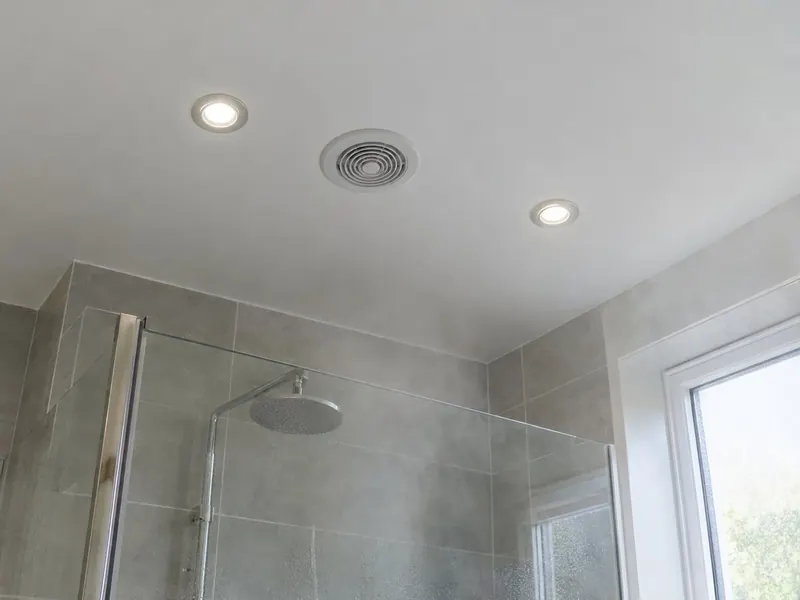
A wall fan on an outside wall is the simplest. A ceiling fan over the shower takes steam away at source but needs ducting through the loft.
Rules that apply in England
A bathroom needs extract ventilation when it is newly formed, and on a refit an existing fan should not be replaced with a less effective one. The fan and its wiring must meet BS 7671 for the zone it sits in, on a circuit with 30 mA RCD protection. In a flat, the lease often requires freeholder consent for a new extract vent, and in a listed building a new opening through an external wall can need listed building consent.
In England, Approved Document F sets bathroom extract at 15 l/s for an intermittent fan or 8 l/s for continuous extract. Wiring a new fan alters a circuit in a room with a bath or shower, so it is notifiable under Part P.