- Postcode districts
- TS18, TS19, TS20
- Nearby
- Billingham, Thornaby-on-Tees and Middlesbrough
- Guide price
- £225–£550
- Typical time on site
- half a day
- Water
- Moderately hard across most of County Durham
- Survey
- Free, at your home
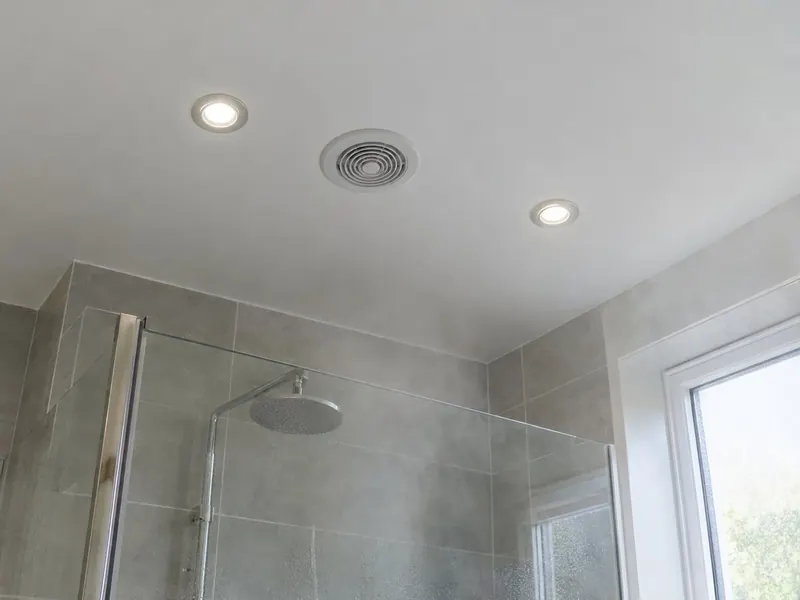
What does a bathroom extractor fan cost in Stockton-on-Tees?
For Stockton-on-Tees, our guide range for a bathroom extractor fan is £225 to £550 including VAT. We adjust the national guide for North East England, where prices are typically about 10% below the UK average. The figure depends on the size of the room, whether anything moves, and the products you pick.
Extractor fan
- Wired to regulations
Inline fan
- Quiet fan in the loft void
Continuous extract
- Boost on humidity
Guide prices for Stockton-on-Tees including VAT. Your itemised written quote after the free survey is the price that counts.
Working in Stockton-on-Tees
We cover every part of Stockton-on-Tees, including TS18, TS19 and TS20, and nearby Billingham (1.8 miles) and Thornaby-on-Tees (2.5 miles).
Across a large town like Stockton-on-Tees, homes range from older terraces to newer estates; the survey tells us which pipework and floor we are dealing with. If your Stockton-on-Tees bathroom has black mould on the ceiling or silicone, the fan and its duct are the first things we check. If your Stockton-on-Tees home is listed or in a period terrace, a fan ducted through the loft to a roof vent can avoid a new hole in the front wall, though consent may still apply.
Water across much of County Durham is moderately hard. Scale is a minor issue next to condensation, which is what a properly sized extractor fan is for. Hardness varies street by street, so check the figure for your postcode with your water supplier.
What the job includes
- A fan chosen to meet the bathroom extract rate: 15 l/s intermittent or 8 l/s continuous
- Wiring by a qualified electrician, with an isolator outside the room and RCD protection
- A backdraught shutter and external grille, so cold air does not blow back in
- Rigid or semi-rigid ducting kept short and straight, and insulated where it crosses a cold loft
Decisions to make first
Replacement air
A fan needs air to replace what it removes, so leave a gap of around 10 mm under the door or fit a door grille. A sealed room starves the fan.
Axial, centrifugal or inline
Axial fans suit short, straight runs; centrifugal fans cope better with longer ducts; inline fans sit in the loft and are the quietest in the room.
Rules that apply in England
In England, Approved Document F sets bathroom extract at 15 l/s for an intermittent fan or 8 l/s for continuous extract. Wiring a new fan alters a circuit in a room with a bath or shower, so it is notifiable under Part P.