
What does a bathroom extractor fan cost on Merseyside?
Our guide range on Merseyside is £235–£550 including VAT. Prices on Merseyside run at about 6% below the UK guide, based on North West England labour rates.
Extractor fan
- Ducted to outside
Inline fan
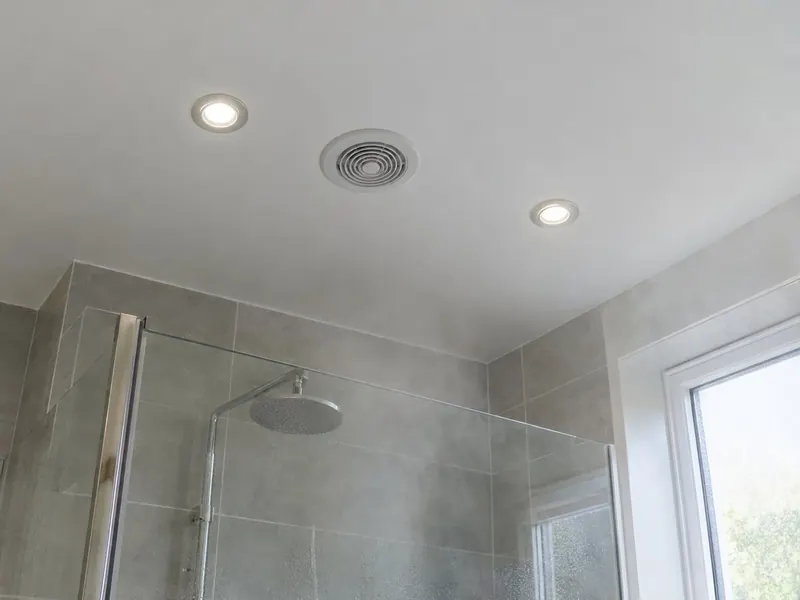
- Grille in the ceiling
Continuous extract
- Low-energy fan running all the time
Guide prices for Merseyside including VAT. Your itemised written quote after the free survey is the price that counts.
Which towns do we cover on Merseyside?
- Liverpool
- Birkenhead
- St Helens
- Southport
- Wallasey
- Bootle
- Bebington
- Huyton
- Kirkby
- Prescot
- Heswall
- Maghull
- Newton-le-Willows
- Golborne
- Formby
- Litherland
- Speke
- Garston
- Halewood
- Moreton
- Haydock
- Hunts Cross
- Allerton
Most of Merseyside is supplied with soft water. Even so, condensation is the bigger problem in any bathroom, and a properly sized extractor is what deals with it. Hardness varies street by street, so check the figure for your postcode with your water supplier. Fans fitted in Liverpool bathrooms are wired by a qualified electrician, with RCD protection and an isolator outside the room.
What the job includes
- Making good around the fan and checking that it extracts properly at the grille
- A backdraught shutter and external grille, so cold air does not blow back in
- A fan chosen to meet the bathroom extract rate: 15 l/s intermittent or 8 l/s continuous
- A check of the room, any existing fan or vent, and the shortest route to the outside
- Run-on timer, humidistat or light-linked switching set up to suit how the room is used
- Rigid or semi-rigid ducting kept short and straight, and insulated where it crosses a cold loft
Decisions to make first
Noise
Compare the stated noise level in decibels. Inline fans and low-speed continuous fans are much quieter in the room than budget axial fans.
Replacement air
A fan needs air to replace what it removes, so leave a gap of around 10 mm under the door or fit a door grille. A sealed room starves the fan.
Axial, centrifugal or inline
Axial fans suit short, straight runs; centrifugal fans cope better with longer ducts; inline fans sit in the loft and are the quietest in the room.
Wall or ceiling
A wall fan on an outside wall is the simplest. A ceiling fan over the shower takes steam away at source but needs ducting through the loft.
Rules that apply in England
A bathroom needs extract ventilation when it is newly formed, and on a refit an existing fan should not be replaced with a less effective one. The fan and its wiring must meet BS 7671 for the zone it sits in, on a circuit with 30 mA RCD protection. In a flat, the lease often requires freeholder consent for a new extract vent, and in a listed building a new opening through an external wall can need listed building consent.
In England, Approved Document F sets bathroom extract at 15 l/s for an intermittent fan or 8 l/s for continuous extract. Wiring a new fan alters a circuit in a room with a bath or shower, so it is notifiable under Part P.