
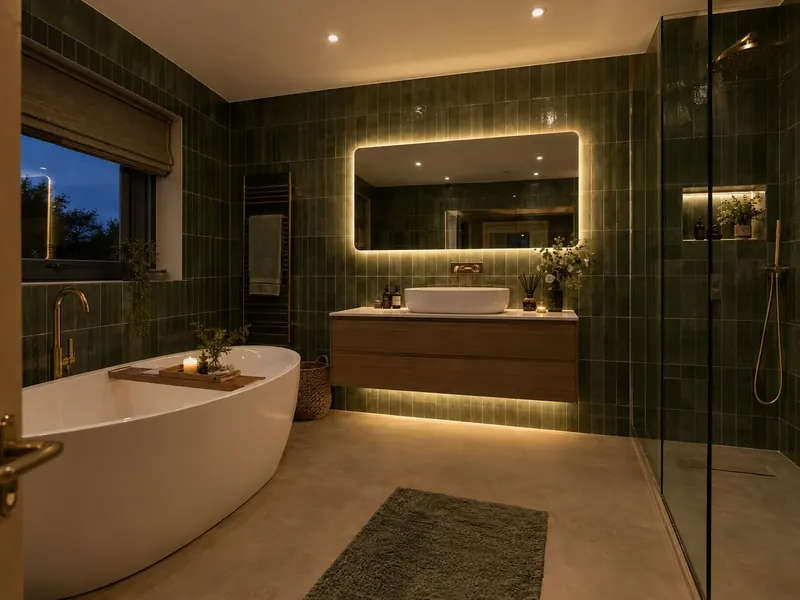
What does new bathroom lighting cost in Dyfed?
Our guide range in Dyfed is £350–£1,100 including VAT. Prices in Dyfed run at about 7% below the UK guide, based on Wales labour rates.
Essential
- Switching and RCD protection
Layered
- Separate switching
Feature
- Niche and plinth LED strips
Guide prices for Dyfed including VAT. Your itemised written quote after the free survey is the price that counts.
Which towns do we cover in Dyfed?
Most of Dyfed is supplied with soft water. That leaves you free to choose matt black, brushed brass or clear glass without worrying much about limescale. Hardness varies street by street, so check the figure for your postcode with your water supplier. If your Llanelli bathroom has one central light, adding downlights and a mirror light is usually the change you notice most.
What the job includes
- Cable runs to each fitting, from the loft above or through the ceiling
- RCD protection on the lighting circuit, checked at the consumer unit and added where it is missing
- A ceiling pull-cord or a switch outside the room, with separate switching for mirror and feature lights
- A shaver supply unit where wanted, positioned away from direct spray
- Testing and an electrical certificate for the work on completion
- A lighting plan: number and position of downlights, mirror lighting, switches and any shaver socket
Decisions to make first
Feature lighting
LED strips in niches, under a wall-hung vanity or along a plinth give enough light for night-time without full glare.
Colour temperature
Warm white, around 3000 K, feels softer; cool white, around 4000 K, is crisper for shaving and make-up. Mixing the two in one room looks uneven.
Integrated or replaceable LED
Integrated LED downlights are slimmer and fully sealed. Fittings with replaceable lamps let you change brightness or colour later.
Switching
A pull-cord inside, a switch outside the door or a motion sensor. Dimmers need LED fittings that are compatible with them.
Rules that apply in Wales
BS 7671 sets the rules for bathroom electrics across the UK. Every circuit in a room with a bath or shower needs 30 mA RCD protection. Zone 0 is inside the bath or shower tray and needs IPX7 fittings; zone 1 is above it up to 2.25 m and needs at least IPX4, or IPX5 where water jets are used; zone 2 extends 0.6 m out from zone 1, where IPX4 is recommended. Sockets other than shaver supply units must be at least 3 m from the zone 1 boundary.
Wales has its own Part P with a wider notifiable list than England, so more bathroom lighting work has to be notified. A registered electrician notifies it and gives you a certificate.