
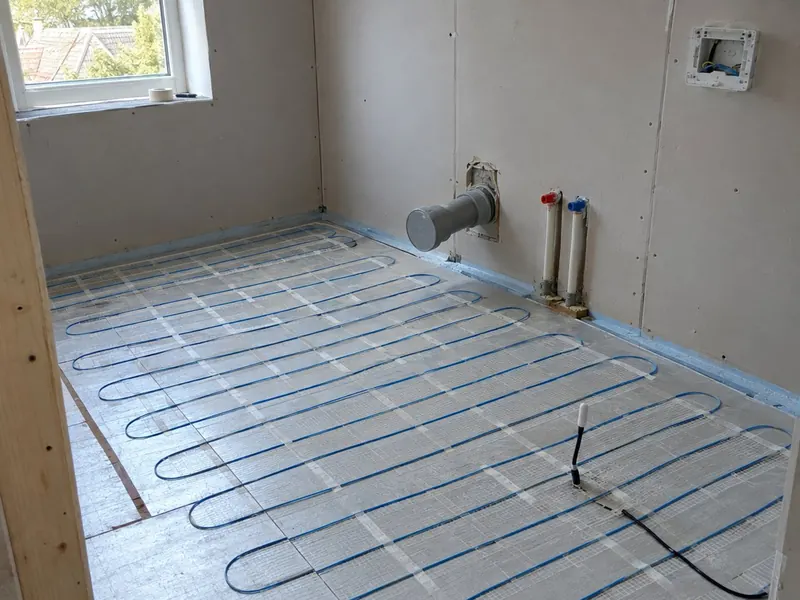
What does bathroom underfloor heating cost on the Isle of Wight?
Our guide range on the Isle of Wight is £800–£2,800 including VAT. Prices on the Isle of Wight run at about 12% above the UK guide, based on South East England labour rates. Travel and delivery to islands and remote areas are priced on your quote.
Electric mat
- Mat under the tiles
Electric, larger room
- Programmable smart thermostat
Wet system
- Screed or low-profile boards
Guide prices for Isle of Wight including VAT. Your itemised written quote after the free survey is the price that counts.
Which towns do we cover on the Isle of Wight?
Water across much of the Isle of Wight is hard. Hard water leaves white marks on dark grout and gloss tiles, so matt finishes and stain-resistant grout are the practical choice. Hardness varies street by street, so check the figure for your postcode with your water supplier. For Newport homes having the bathroom floor replaced, underfloor heating adds one to two days to the fit.
What the job includes
- Bringing the system up to temperature gradually once the adhesive and grout have cured
- For wet systems, pipes in low-profile boards or screed connected to a manifold or single-zone kit, with any boiler work done by a Gas Safe registered engineer
- Insulation boards over the subfloor, so heat goes up into the tiles rather than down into the joists or screed
- Resistance and insulation tests on the mat before, during and after tiling, with the readings recorded
- A dial, programmable or smart thermostat, with the supply RCD protected, tested and certified by a qualified electrician
- A floor sensor set between the heating runs and wired back to the thermostat
Decisions to make first
Mat or loose cable
Mats are quickest on square, open floors. Loose cable is easier to route around awkward shapes, pipe boxing and a curved shower area.
Thermostat
A simple dial thermostat, a programmable one with set times, or a smart thermostat you can control from your phone.
Insulation board thickness
Thicker boards warm up faster and lose less heat downwards, but raise the floor; the right choice depends on the door threshold and the next room.
Floor heating and towel rail
Underfloor heating warms the room; a towel rail dries towels. Many bathrooms have both, and a dual-fuel rail keeps working in summer when the boiler is off.
Rules that apply in England
Electric underfloor heating in a bathroom must be on a circuit with 30 mA RCD protection under BS 7671, and the thermostat is positioned to suit the bathroom zones. There is no separate approval for the heating itself, but it should have its own thermostat and timer so it only runs when needed, and the electrical work must meet BS 7671 — in England and Wales it is notifiable as bathroom electrical work. Any work on a gas boiler for a wet system must be done by a Gas Safe registered engineer.
In England, a new circuit for underfloor heating is notifiable under Part P, and so is connecting it to an existing circuit in a room with a bath or shower. The electrician either self-certifies through a competent person scheme or the work is notified to building control.