
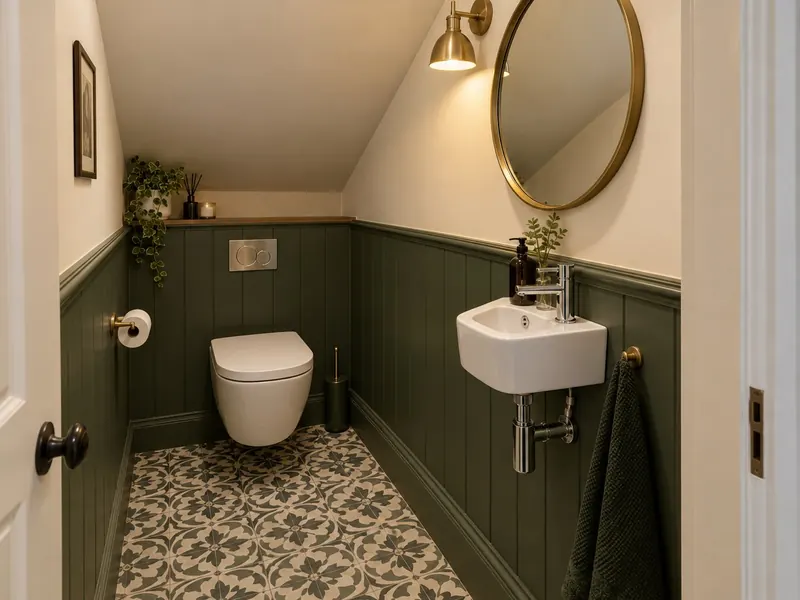
What does a cloakroom or downstairs WC cost in Bedfordshire?
Our guide range in Bedfordshire is £1,900–£4,800 including VAT. Prices in Bedfordshire run at about 6% above the UK guide, based on East of England labour rates.
Refit
- Splashback tiling, new floor
Upgrade
- Wall-hung WC with concealed frame
New cloakroom
- New waste or macerator
Guide prices for Bedfordshire including VAT. Your itemised written quote after the free survey is the price that counts.
Which towns do we cover in Bedfordshire?
Water across much of Bedfordshire is very hard. Taps, plug wastes and toilet pans scale up quickly, so chrome copes better than matt black, and a removable aerator is worth having. Hardness varies street by street, so check the figure for your postcode with your water supplier. Where your Luton home already has a WC on gravity drainage, a macerator opens up more places a new cloakroom can go.
What the job includes
- Compact sanitaryware: a short-projection, back-to-wall or wall-hung WC and a corner, wall-hung or slim vanity basin
- Lighting wired by a qualified electrician, tested and certified
- A concealed cistern frame or WC unit where the space allows
- A new waste connection to the soil stack or drain, or a macerator where the rules allow it
- Splashback or feature tiling and a new floor, often LVT or porcelain
- A survey that checks the headroom under the stairs, the door swing and how the waste will reach the drain
Decisions to make first
WC style
A wall-hung WC on a frame gives the most floor space and looks neat. A back-to-wall pan in a short furniture unit is easier to fit against an uneven wall.
Door
An outward-opening door is usually needed so it does not hit the WC. A sliding door suits a narrow hallway where an outward door would block the way.
Macerator or gravity
Gravity drainage is silent and needs no maintenance. A macerator lets a WC go where a pipe could not otherwise fall, provided another WC in the house is on gravity drainage.
Under-stair layout
Headroom drops quickly under stairs. The basin and the space in front of the WC need standing height; the low end of the room can take the cistern or storage.
Rules that apply in England
A cloakroom refit does not need planning permission, and forming a new one inside the house rarely does, although a listed building needs listed building consent for internal alterations affecting its character. A macerator or pumped WC is acceptable only where the home also has a WC on gravity drainage. The water fittings rules in each nation limit a new WC to a 6-litre flush.
In England, a new WC connected to the soil stack or drain is drainage work under Part H, and a newly formed cloakroom without an opening window should have mechanical extract; Approved Document F gives 6 litres per second as the design rate for a WC, against 15 for a bathroom. Because a cloakroom has no bath or shower, adding a light to an existing circuit is not notifiable under Part P, but a new circuit is.