
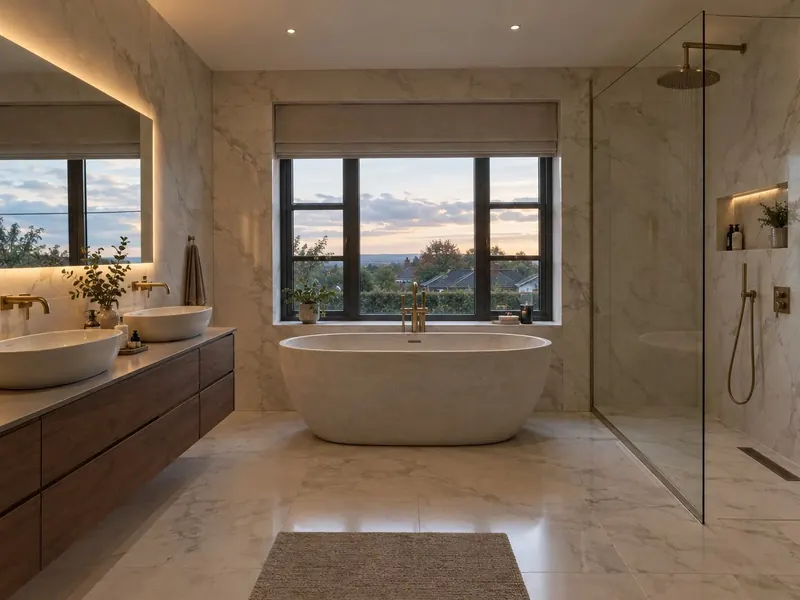
What does a luxury bathroom cost in South Glamorgan?
Our guide range in South Glamorgan is £11,250–£23,250 including VAT. Prices in South Glamorgan run at about 7% below the UK guide, based on Wales labour rates.
Premium
- Designer brassware and wall-hung pieces
Signature
- Underfloor heating, layered lighting
Statement
- Natural stone or microcement
Guide prices for South Glamorgan including VAT. Your itemised written quote after the free survey is the price that counts.
Which towns do we cover in South Glamorgan?
Water across much of South Glamorgan is moderately hard. Easy-clean glass and good-quality brassware are money well spent. Hardness varies street by street, so check the figure for your postcode with your water supplier. For a stone or cast-iron bath in a Cardiff property, we check the floor structure before anything is ordered.
What the job includes
- A detailed survey of the floor structure, hot-water capacity, water pressure and flow
- Bespoke fitted furniture, mitred tile edges and recessed niches
- Concealed thermostatic or digital shower valves, set into the wall to the depth the manufacturer specifies
- Large-format porcelain, natural stone or microcement over full tanking
- Floor strengthening where a stone-resin, cast-iron or natural stone bath needs it
- Underfloor heating, layered lighting and any steam unit wired by a qualified electrician, tested and certified
Decisions to make first
Wall and floor finish
Large-format porcelain gives a stone look with little upkeep. Natural stone and microcement are beautiful but need sealing and care, especially in hard-water areas.
Freestanding bath material
Acrylic is light and warm to the touch. Stone resin holds heat and feels solid but is much heavier. Cast iron is the heaviest of all and nearly always needs a structural check.
Lighting
Layer it: IP-rated ceiling lights for general use, a lit mirror at the basin and low-level LED in niches or plinths for night, each on its own switch or dimmer.
Shower system
A concealed thermostatic valve with a ceiling head and handset is the usual choice. A digital valve sets the temperature from a wall panel, and a steam enclosure needs its own generator and supply.
Rules that apply in Wales
Internal bathroom work does not need planning permission, but a listed building needs listed building consent for alterations affecting its character, including new soil or vent pipes through walls. Heavy baths and stone floors add load to the floor structure, which should be checked first. Electrics must meet BS 7671, including the IP ratings in each zone and 30 mA RCD protection on every circuit.
Wales has its own Part P with a wider notifiable list than England, so the new electrical work should be notified and certified. An unvented cylinder still needs a G3-qualified installer, and boiler work a Gas Safe registered engineer.