
What does a replacement bath cost in County Tyrone?
Our guide range in County Tyrone is £800–£2,200 including VAT. Prices in County Tyrone run at about 12% below the UK guide, based on Northern Ireland labour rates.
Like-for-like bath
- New acrylic or steel bath, panel and taps
Shower bath
- Re-tiling to the bath area
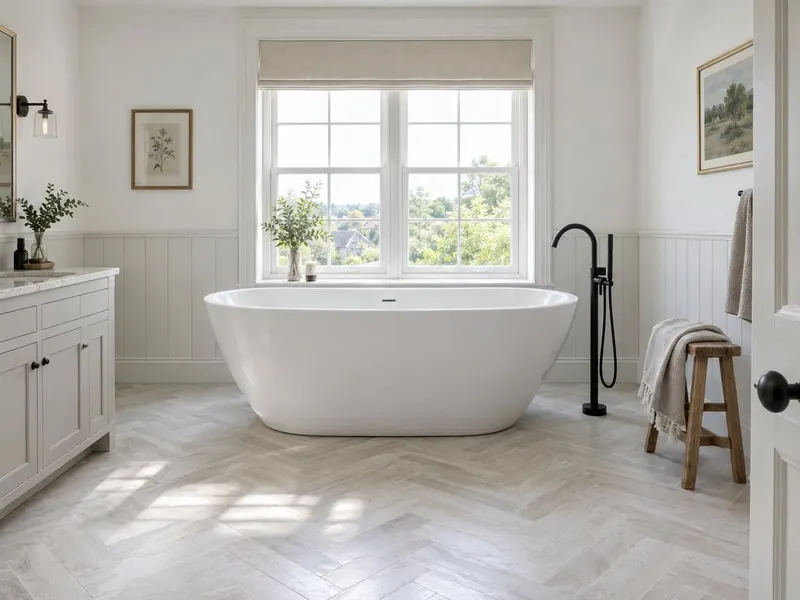
Freestanding bath
- Freestanding acrylic or stone resin
Guide prices for County Tyrone including VAT. Your itemised written quote after the free survey is the price that counts.
Which towns do we cover in County Tyrone?
Supplies across most of County Tyrone are soft. In soft water, taps, wastes and toilet pans scale up slowly, so brushed and matt finishes are a safe choice. Hardness varies street by street, so check the figure for your postcode with your water supplier. Landlords with properties in Omagh can usually have a bath replaced between tenancies in one to two working days.
What the job includes
- Levelling the bath on adjustable feet or a cradle, with timber battens fixed to the walls under the rim
- Removal of the old bath, including breaking up a cast-iron bath in place where it will not come out whole
- Leak testing at the waste, overflow and taps, taking the old bath away and a final clean
- A survey of the bath opening, the floor, the waste route, the supplies and the tiles around the bath
- Tile repairs or re-tiling around the bath, and a fixed screen where there is a shower over it
- Filling the bath before sealing, so the silicone cures with the bath at its heaviest
Decisions to make first
Shower bath
A P-shaped or L-shaped bath is wider at the shower end, giving room to stand and space for a fixed screen instead of a curtain.
Freestanding bath
Acrylic freestanding baths are manageable on most floors; stone resin and cast iron are much heavier when full. You need room to clean round the bath and a plan for where the waste and filler come up.
Size
Most UK baths are 1700 × 700 mm. Going longer or wider than the old bath means re-tiling and checking that the new one fits up the stairs.
Taps or filler
Deck taps on the rim are the simplest swap. Wall-mounted taps or a bath filler look cleaner but mean opening the wall, and an overflow filler hides the spout altogether.
Rules that apply in Northern Ireland
Replacing a bath in an existing bathroom does not need planning permission, and a straight swap is not normally building regulations work. New taps or a filler must meet the water fittings rules where you live, including backflow protection. If the new bath is much heavier than the old one, such as a cast-iron or stone resin freestanding bath, the floor needs checking, and strengthening joists is structural work that may need building control approval.
In Northern Ireland, the Water Supply (Water Fittings) Regulations (Northern Ireland) 2009 apply to the new taps or filler. Building control is involved only if the floor structure or drainage is altered.