- Postcode districts
- NR1, NR2, NR3, NR4, NR5, NR6 + 1 more
- Nearby
- East Dereham, Great Yarmouth and Lowestoft
- Guide price
- £650–£4,200
- Typical time on site
- 1–5 working days
- Water
- Very hard across most of Norfolk
- Survey
- Free, at your home
What does bathroom plumbing work cost in Norwich?
In Norwich, bathroom plumbing work typically costs £650–£4,200 including VAT, based on East of England prices. We adjust the national guide for East of England, where prices are typically about 6% above the UK average. The figure depends on the size of the room, whether anything moves, and the products you pick.
Like-for-like
- Isolation valves, new tails
Partial re-route
- Waste re-routed
New layout
- WC moved on the soil stack
Guide prices for Norwich including VAT. Your itemised written quote after the free survey is the price that counts.
Working in Norwich
We work right across Norwich — NR1, NR2, NR3 and 4 more postcode districts — and in neighbouring East Dereham and Great Yarmouth.
In a city the size of Norwich, parking and access for a skip are worth sorting before the start date — we will ask at the survey. In Norwich flats, any change to the WC or wastes is planned with the lease and the flat below in mind. For Norwich homes on a combi boiler, we measure the flow rate at the bathroom before you choose a shower valve.
Most of Norfolk has very hard water. Taps, plug wastes and toilet pans scale up quickly, so chrome copes better than matt black, and a removable aerator is worth having. Hardness varies street by street, so check the figure for your postcode with your water supplier.
What the job includes
- A check of your hot water system, and the pressure and flow rate at the bathroom
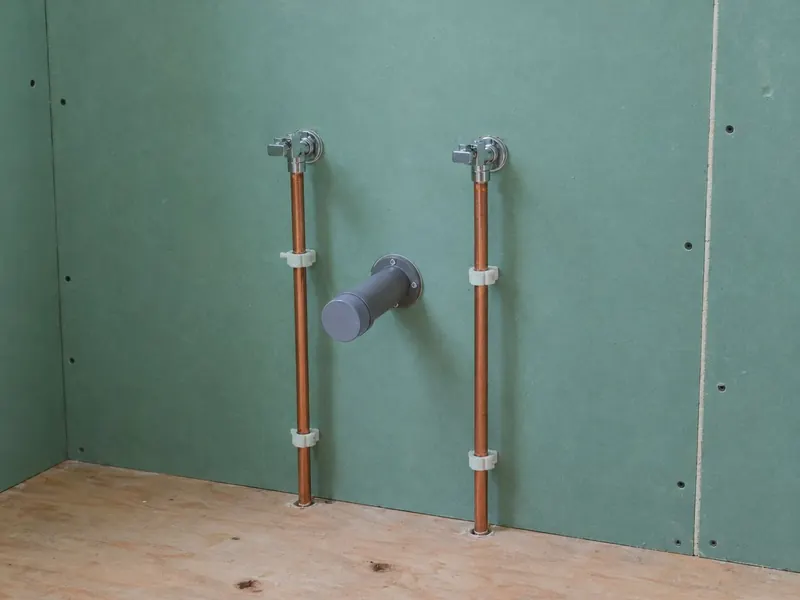
- New hot and cold pipework in copper or plastic, properly clipped, and insulated where it runs through cold spaces
- Basin, bath and shower wastes sized and laid to a steady fall, with traps that hold their water seal
- The WC connected to the soil stack, or a new branch where the WC is moving
Decisions to make first
Gravity or pumped waste
Gravity drainage is always the first choice. A shower waste pump or macerator solves a run that cannot fall, but adds noise, a power supply and servicing.
Pipe routes
Drilling through the middle of joists, rather than notching the tops, keeps the floor strong. Routes are planned with the joist direction in mind.
Rules that apply in England
In England, the Water Supply (Water Fittings) Regulations 1999 apply. New drainage or a new connection to the soil stack can be building regulations work under Part H, and a macerator or pumped WC is acceptable only where there is also a WC on gravity drainage elsewhere in the home.