- Postcode districts
- NR1, NR2, NR3, NR4, NR5, NR6 + 1 more
- Nearby
- East Dereham, Great Yarmouth and Lowestoft
- Guide price
- £1,600–£6,400
- Typical time on site
- 1–3 working days
- Water
- Very hard across most of Norfolk
- Survey
- Free, at your home
What does fitted bathroom furniture cost in Norwich?
As a guide, budget £1,600 to £6,400 including VAT for fitted bathroom furniture in Norwich; your written quote will pin it down. Labour costs in East of England put local prices at about 6% above the UK guide figure. The figure depends on the size of the room, whether anything moves, and the products you pick.
Compact run
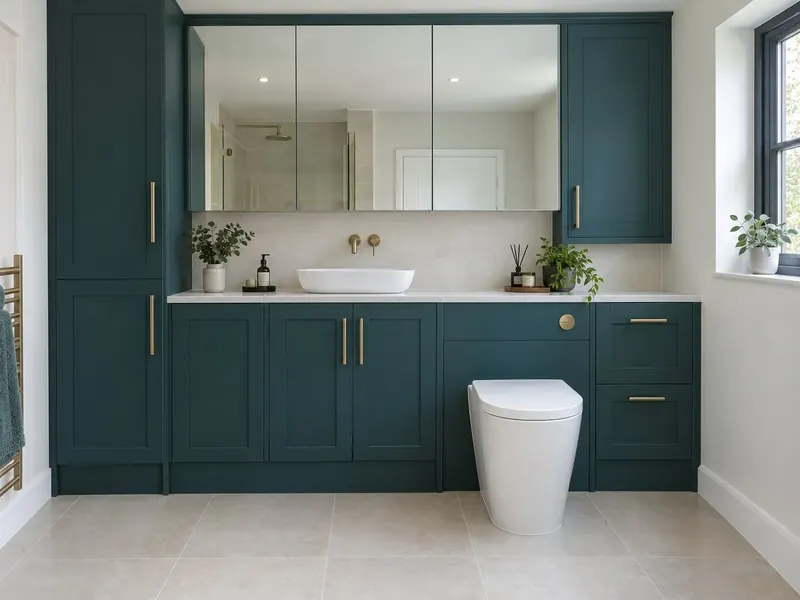
- Vanity and WC unit with concealed cistern
Full fitted run
- Quartz-effect or solid-surface top
Wall-to-wall
- Made to suit awkward spaces
Guide prices for Norwich including VAT. Your itemised written quote after the free survey is the price that counts.
Working in Norwich
As well as Norwich itself (NR1, NR2, NR3 and 4 more postcode districts), we survey in East Dereham, Great Yarmouth and Lowestoft.
Norwich is a big place with every kind of home, from terraces to flats to new builds, so we never price from a photo alone. Rented homes in Norwich are well served by slab doors and sealed worktops, which stand up to a change of tenants. If you are in Norwich and short of storage, a tall unit at the end of the run holds what would otherwise sit on the floor.
Most of Norfolk has very hard water. Taps, plug wastes and toilet pans scale up quickly, so chrome copes better than matt black, and a removable aerator is worth having. Hardness varies street by street, so check the figure for your postcode with your water supplier.
What the job includes
- A concealed cistern or cistern frame, with an isolation valve you can reach through the flush plate or a panel
- Fillers and end panels scribed to the walls, and the worktop sealed with silicone
- Measuring every wall for length, height and how far it is out of square
- Removal of the old basin, WC or cabinets, with redundant supplies capped
Decisions to make first
Cistern type
A back-to-wall pan can use a cistern that sits inside the WC unit, which is simple to service. A wall-hung WC needs a load-bearing frame built in behind the run.
Door style
Slab doors are the easiest to wipe down. Shaker doors look traditional but have grooves that collect dust. Handleless push-to-open doors suit a plain, modern room.
Rules that apply in England
In England, wiring a lit mirror or plinth lights means altering a circuit in a room with a bath or shower, which is notifiable under Part P. The Water Supply (Water Fittings) Regulations 1999 cover the new WC and basin taps.