
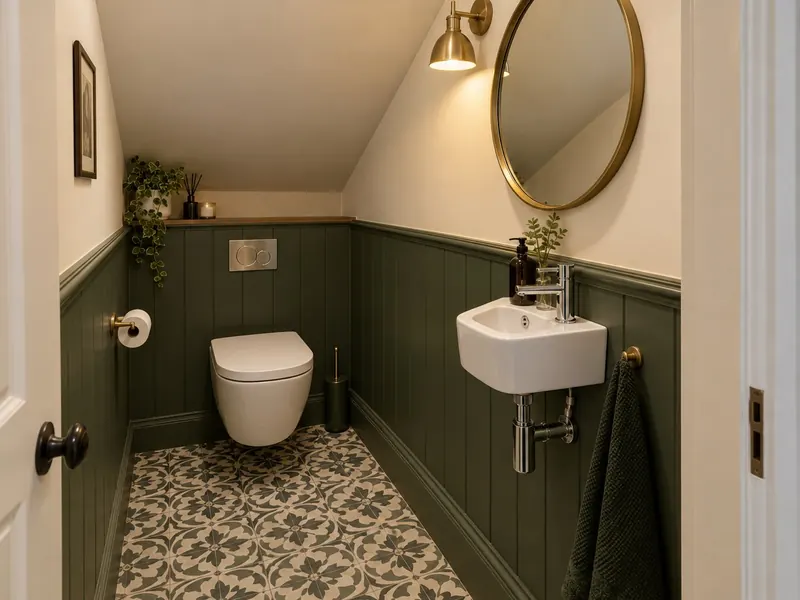
What does a cloakroom or downstairs WC cost in the Forth Valley?
Our guide range in the Forth Valley is £1,750–£4,300 including VAT. Prices in the Forth Valley run at about 4% below the UK guide, based on Scotland labour rates.
Refit
- Compact WC and corner or wall basin
Upgrade
- Feature tiles and lighting
New cloakroom
- Formed under the stairs or in a utility
Guide prices for Forth Valley including VAT. Your itemised written quote after the free survey is the price that counts.
Which towns do we cover in the Forth Valley?
Most of the Forth Valley is supplied with soft water. In soft water, taps, wastes and toilet pans scale up slowly, so brushed and matt finishes are a safe choice. Hardness varies street by street, so check the figure for your postcode with your water supplier. For a new cloakroom in Stirling, the first thing we look at is where the nearest drain or soil stack runs.
What the job includes
- Compact sanitaryware: a short-projection, back-to-wall or wall-hung WC and a corner, wall-hung or slim vanity basin
- Strip-out of the old fittings, waste removal and making good on the hall side
- Lighting wired by a qualified electrician, tested and certified
- An extractor fan ducted to outside, wired with an overrun timer or linked to the light
- A concealed cistern frame or WC unit where the space allows
- A new waste connection to the soil stack or drain, or a macerator where the rules allow it
Decisions to make first
WC style
A wall-hung WC on a frame gives the most floor space and looks neat. A back-to-wall pan in a short furniture unit is easier to fit against an uneven wall.
Under-stair layout
Headroom drops quickly under stairs. The basin and the space in front of the WC need standing height; the low end of the room can take the cistern or storage.
Door
An outward-opening door is usually needed so it does not hit the WC. A sliding door suits a narrow hallway where an outward door would block the way.
Macerator or gravity
Gravity drainage is silent and needs no maintenance. A macerator lets a WC go where a pipe could not otherwise fall, provided another WC in the house is on gravity drainage.
Rules that apply in Scotland
A cloakroom refit does not need planning permission, and forming a new one inside the house rarely does, although a listed building needs listed building consent for internal alterations affecting its character. A macerator or pumped WC is acceptable only where the home also has a WC on gravity drainage. The water fittings rules in each nation limit a new WC to a 6-litre flush.
In Scotland, forming a new WC that alters drainage may need a building warrant, while refitting an existing cloakroom normally does not. Water fittings are covered by the Scottish Water Byelaws 2014, and electrics should be tested and certified to BS 7671.