
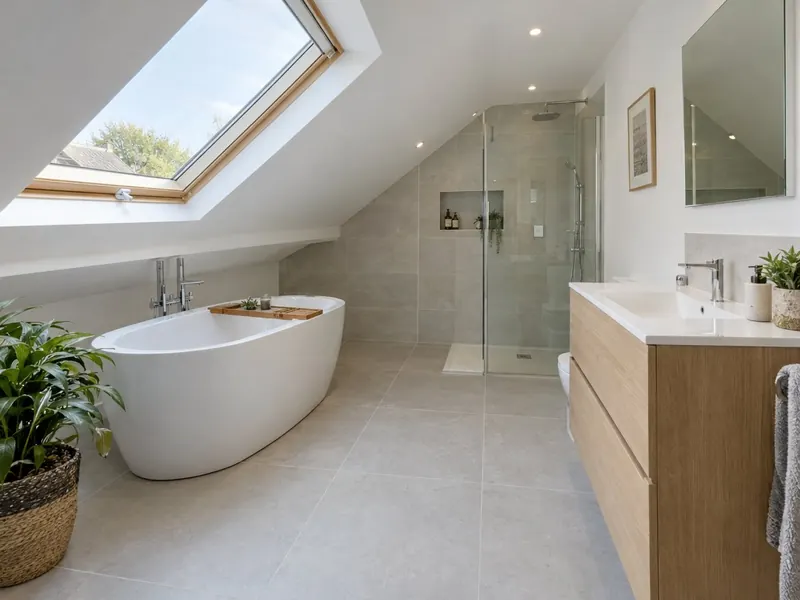
What does a loft bathroom cost in Tyne and Wear?
Our guide range in Tyne and Wear is £5,800–£11,750 including VAT. Prices in Tyne and Wear run at about 10% below the UK guide, based on North East England labour rates.
Refit
- Shower, basin and WC replaced
Signature
- Pump or macerator where needed
New loft bathroom
- Formed in an existing loft room
Guide prices for Tyne and Wear including VAT. Your itemised written quote after the free survey is the price that counts.
Which towns do we cover in Tyne and Wear?
- Newcastle upon Tyne
- Sunderland
- South Shields
- Gateshead
- Washington
- Tynemouth
- Wallsend
- Newburn
- North Shields
- Whitley Bay
- Houghton-Le-Spring
- Felling
- Jarrow
- Gosforth
- Hebburn
- Whickham
- Blaydon-on-Tyne
Most of Tyne and Wear is supplied with soft water. If that holds for your street in Newcastle upon Tyne, limescale on shower glass and heads builds up slowly and a squeegee after use is usually enough. Hardness varies street by street, so check the figure for your postcode with your water supplier. For a loft bathroom in a tank-fed Newcastle upon Tyne home, we work out how the shower will get its pressure before choosing a single fitting.
What the job includes
- An extractor fan ducted through the roof or a gable wall, with the duct insulated through cold spaces
- Fitted furniture made to the eaves, so the low space behind the slope becomes storage
- A drainage route from the loft to the soil stack with enough fall, or a pumped waste or macerator where the rules allow it
- A survey of the headroom across the room, with the usable height marked at each fitting position
- A shower pump on a gravity system, an electric shower, or advice on moving to mains pressure, depending on your system
- Electrics by a qualified electrician, tested and certified, then tiling, testing and handover
Decisions to make first
Where the shower goes
Under the ridge or in a dormer, where the full height is. A walk-in shower with a single panel is usually easier to fit to a roof line than a framed enclosure.
Getting the water pressure
A pumped shower suits a gravity system with a cold tank; an electric shower heats cold mains water at the point of use; a combi or unvented cylinder gives mains pressure throughout.
Gravity or pumped waste
Gravity is silent and maintenance-free. A pumped waste or macerator lets fittings sit away from the stack, provided the house has a WC on gravity drainage elsewhere.
Bath or no bath
A bath under the slope makes good use of low space, but the floor has to carry it when it is full of water and someone is in it.
Rules that apply in England
A bathroom inside an existing loft room does not usually need planning permission, but forming one is normally building-regulations work because of the new drainage, extract ventilation and electrics. A macerator or pumped WC is acceptable only where the home also has a WC on gravity drainage. Under the water fittings rules, a shower pump must never be connected directly to the mains supply.
In England, new drainage and a new connection to the soil stack fall under Part H, a new bathroom needs extract of 15 litres per second intermittent or 8 litres per second continuous under Approved Document F, and new circuits are notifiable under Part P. If the work includes an unvented hot-water cylinder, it must be fitted by a G3-qualified installer.