
What does a new shower cost in Bristol?
Our guide range in Bristol is £450–£3,600 including VAT.
Shower swap
- Existing supply and position
New shower over bath
- Tiling the bath surround
New shower with enclosure
- Tray, enclosure and valve
Guide prices for Bristol including VAT. Your itemised written quote after the free survey is the price that counts.
Which towns do we cover in Bristol?
Water across much of Bristol is hard. If your supply in Bishopsworth is the same, limescale on shower glass and heads is a real issue: easy-clean glass, rub-clean nozzles and a squeegee make a big difference. Hardness varies street by street, so check the figure for your postcode with your water supplier. We test pressure and flow at Bishopsworth surveys before recommending a shower, so you know how it will perform before you buy.
What the job includes
- Tiling or re-tiling around the shower, with tanking behind new tiles in the wet area
- A bath screen, tray or enclosure where the shower is new
- Supply and fitting of the shower valve or unit, riser rail, handset or fixed head
- A check of your hot-water system, water pressure and flow rate
- Electrical connection by a qualified electrician, tested and certified
- For an electric shower, a check of the consumer unit and whether a new dedicated circuit is needed
Decisions to make first
Exposed or concealed
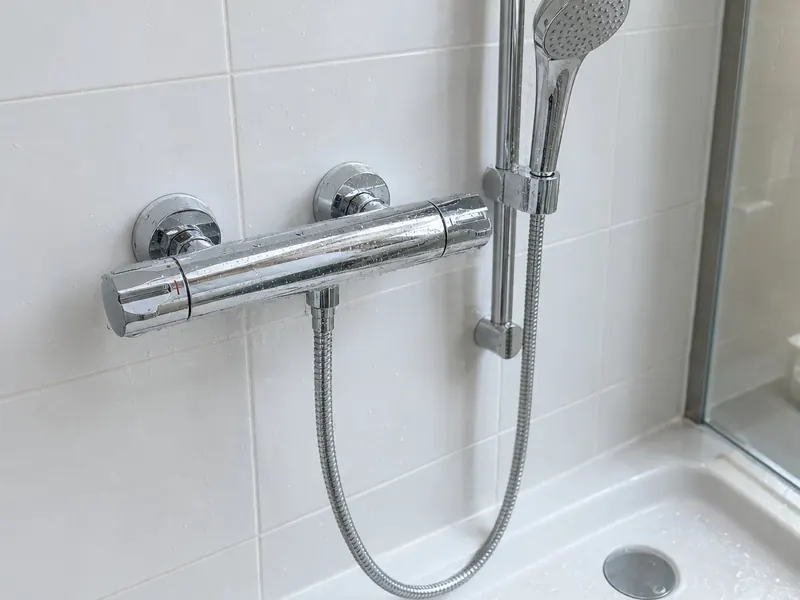
An exposed bar valve fixes onto the tiles and is easy to service. A concealed valve sits in the wall for a cleaner look but needs careful setting-out and a plan for access.
Power shower
A mixer with a built-in pump, for tank-fed systems only. It lifts a weak gravity shower but must never be connected to the mains.
Digital shower
A wall panel sets the exact temperature and flow, while the mixing valve sits out of sight. It needs a power supply and suits a clean, concealed look.
Electric shower
Heats cold mains water as it flows, so it works without stored hot water. Higher kW units give more flow; 8.5 to 10.5 kW models need a dedicated circuit, often 40 to 45 amps.
Rules that apply in England
The water fittings regulations in each nation do not allow a pump to be connected directly to the mains supply; shower pumps are for gravity systems with a cold tank only. The shower must also be protected against water flowing back into the supply. Electrics must meet BS 7671, with 30 mA RCD protection and at least IPX4 fittings in zone 1, or IPX5 where water jets are used.
In England, an electric shower usually needs its own dedicated circuit, often 40 to 45 amps for an 8.5 to 10.5 kW unit, and a new circuit is notifiable under Part P. The Part G limit of 48 °C applies to a new bath in a new dwelling or one created by change of use, not to a shower, but a thermostatic valve gives similar protection. An unvented cylinder fitted to improve the shower must be installed by a G3-qualified installer.