
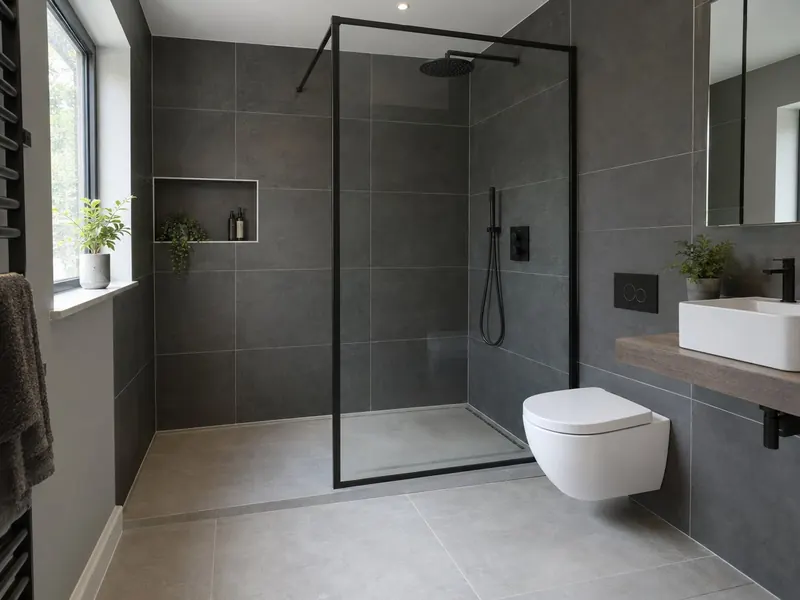
What does a shower room cost in Dyfed?
Our guide range in Dyfed is £4,200–£8,400 including VAT. Prices in Dyfed run at about 7% below the UK guide, based on Wales labour rates.
Essential
- Tray, enclosure and mixer shower
Signature
- Fitted vanity and concealed cistern
Bespoke
- Underfloor heating, mirror cabinet
Guide prices for Dyfed including VAT. Your itemised written quote after the free survey is the price that counts.
Which towns do we cover in Dyfed?
Most of Dyfed is supplied with soft water. If that holds for your street in Llanelli, limescale on shower glass and heads builds up slowly and a squeegee after use is usually enough. Hardness varies street by street, so check the figure for your postcode with your water supplier. If your second bathroom in Llanelli is too narrow for a bath, a long walk-in tray can often fit along the same wall.
What the job includes
- A thermostatic shower valve, exposed or concealed, with a fixed head, a handset or both
- A survey of water pressure and flow, the hot-water system and the floor where the tray or former will sit
- An enclosure, walk-in panel or frameless screen in toughened safety glass
- Recessed niches or shelving in the shower wall
- A basin and WC to suit the space, freestanding or set into a fitted furniture run
- A low-profile tray or a tiled level floor, with the waste positioned for a good fall
Decisions to make first
Glass
8 mm toughened glass is the usual standard for a walk-in panel. An easy-clean coating helps a great deal in hard-water areas.
Storage
With no bath, there is often space for a full-width vanity unit or a tall cupboard for towels.
Valve and heads
A bar valve is simple and easy to service. A concealed valve with a ceiling head looks cleaner but needs good flow to perform.
Tray size
A 1200 by 800 mm or 1400 by 900 mm tray with a single panel makes a comfortable walk-in. Go as long as the room allows; length does more than width to keep spray inside.
Rules that apply in Wales
Turning a bathroom into a shower room does not need planning permission. The electrics must meet BS 7671: 30 mA RCD protection on every circuit, at least IPX4 fittings in zone 1 above the tray up to 2.25 m, or IPX5 where water jets are used, and no ordinary sockets within 3 m of zone 1. A shower pump can only be used on a gravity system with a cold tank, never connected directly to the mains.
Wales has its own Part P and Part F. More electrical work is notifiable there than in England, and the extract rates are similar.