
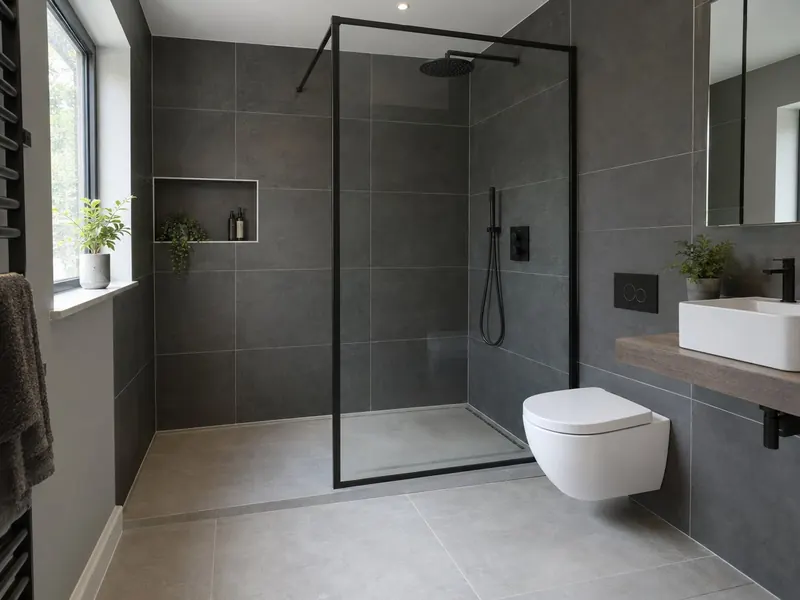
What does a shower room cost in Powys?
Our guide range in Powys is £4,200–£8,400 including VAT. Prices in Powys run at about 7% below the UK guide, based on Wales labour rates.
Essential
- Tiling to the shower area
Signature
- Large walk-in tray and frameless screen
Bespoke
- Concealed thermostatic or digital shower
Guide prices for Powys including VAT. Your itemised written quote after the free survey is the price that counts.
Which towns do we cover in Powys?
Water across much of Powys is soft. If that holds for your street in Newtown, limescale on shower glass and heads builds up slowly and a squeegee after use is usually enough. Hardness varies street by street, so check the figure for your postcode with your water supplier. For shower rooms in Newtown, we check the water pressure and hot-water system at the survey, because that decides how well the shower will perform.
What the job includes
- A survey of water pressure and flow, the hot-water system and the floor where the tray or former will sit
- A basin and WC to suit the space, freestanding or set into a fitted furniture run
- A low-profile tray or a tiled level floor, with the waste positioned for a good fall
- Removal of the old bath and suite, waste removal, testing and handover
- Recessed niches or shelving in the shower wall
- Extractor fan, lighting and towel rail wired by a qualified electrician, tested and certified
Decisions to make first
Tray or level floor
A low-profile stone-resin tray is quicker to fit and costs less. A tiled level floor looks seamless but needs a former, tanking and more floor preparation.
Drain
A centre waste in a tray is the norm. A linear drain along one wall lets a tiled floor fall one way, so large tiles can run through.
Glass
8 mm toughened glass is the usual standard for a walk-in panel. An easy-clean coating helps a great deal in hard-water areas.
Storage
With no bath, there is often space for a full-width vanity unit or a tall cupboard for towels.
Rules that apply in Wales
Turning a bathroom into a shower room does not need planning permission. The electrics must meet BS 7671: 30 mA RCD protection on every circuit, at least IPX4 fittings in zone 1 above the tray up to 2.25 m, or IPX5 where water jets are used, and no ordinary sockets within 3 m of zone 1. A shower pump can only be used on a gravity system with a cold tank, never connected directly to the mains.
Wales has its own Part P and Part F. More electrical work is notifiable there than in England, and the extract rates are similar.