- Postcode districts
- CO13, CO14
- Nearby
- Walton-on-the-Naze, Clacton-on-Sea and Harwich
- Guide price
- £750–£2,600
- Typical time on site
- 1–2 working days (added to a fit)
- Water
- Very hard across most of Essex
- Survey
- Free, at your home
What does bathroom underfloor heating cost in Frinton-on-Sea?
Guide price in Frinton-on-Sea: £750–£2,600 including VAT, depending on the room and what you choose. Prices in East of England run at about 6% above the national guide, mainly because of labour rates. The figure depends on the size of the room, whether anything moves, and the products you pick.
Electric mat
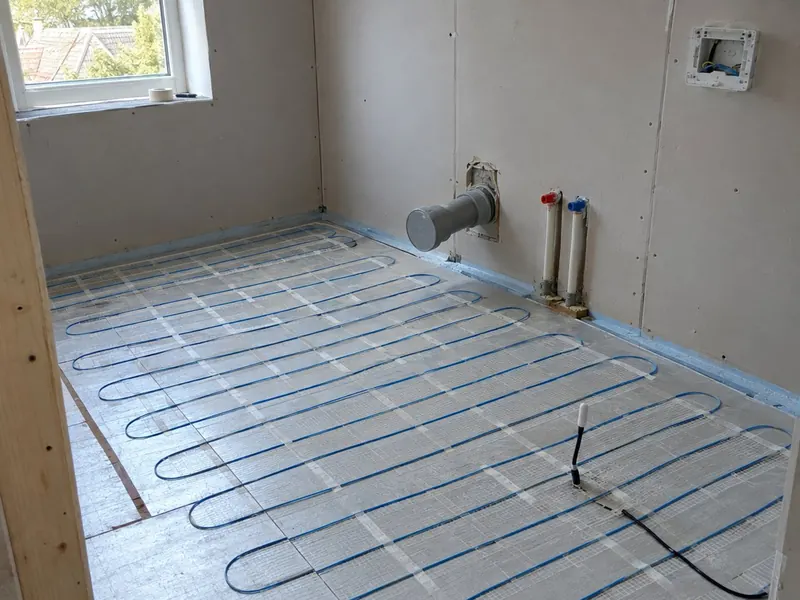
- Mat under the tiles
Electric, larger room
- Programmable smart thermostat
Wet system
- Screed or low-profile boards
Guide prices for Frinton-on-Sea including VAT. Your itemised written quote after the free survey is the price that counts.
Working in Frinton-on-Sea
As well as Frinton-on-Sea itself (CO13 and CO14), we survey in Walton-on-the-Naze, Clacton-on-Sea and Harwich.
Being a smaller town does not change how we work in Frinton-on-Sea: free survey, written quote, one team. For Frinton-on-Sea homes having the bathroom floor replaced, underfloor heating adds one to two days to the fit. We check door thresholds in Frinton-on-Sea homes at the survey, because underfloor heating and new tiles raise the floor slightly.
Supplies across most of Essex are very hard. Hard water leaves white marks on dark grout and gloss tiles, so matt finishes and stain-resistant grout are the practical choice. Hardness varies street by street, so check the figure for your postcode with your water supplier.
What the job includes
- For wet systems, pipes in low-profile boards or screed connected to a manifold or single-zone kit, with any boiler work done by a Gas Safe registered engineer
- Insulation boards over the subfloor, so heat goes up into the tiles rather than down into the joists or screed
- A dial, programmable or smart thermostat, with the supply RCD protected, tested and certified by a qualified electrician
- A floor sensor set between the heating runs and wired back to the thermostat
Decisions to make first
Insulation board thickness
Thicker boards warm up faster and lose less heat downwards, but raise the floor; the right choice depends on the door threshold and the next room.
Electric or wet
Electric is cheaper to install and quick to lay in one room. Wet costs more upfront but is usually cheaper to run where it is fed by a gas boiler or heat pump.
Rules that apply in England
In England, a new circuit for underfloor heating is notifiable under Part P, and so is connecting it to an existing circuit in a room with a bath or shower. The electrician either self-certifies through a competent person scheme or the work is notified to building control.