- Postcode districts
- EH18, EH19, EH24
- Nearby
- Musselburgh, Penicuik and Colinton
- Guide price
- £650–£2,400
- Typical time on site
- 1–2 working days (added to a fit)
- Water
- Soft across most of the Lothians
- Survey
- Free, at your home
What does bathroom underfloor heating cost in Bonnyrigg?
In Bonnyrigg, bathroom underfloor heating typically costs £650–£2,400 including VAT, based on Scotland prices. Prices in Scotland run at about 4% below the national guide, mainly because of labour rates. The figure depends on the size of the room, whether anything moves, and the products you pick.
Electric mat
- Thermostat and RCD-protected supply
Electric, larger room
- Whole floor coverage
Wet system
- Manifold or single-zone kit
Guide prices for Bonnyrigg including VAT. Your itemised written quote after the free survey is the price that counts.
Working in Bonnyrigg
We work right across Bonnyrigg — EH18, EH19 and EH24 — and in neighbouring Musselburgh and Penicuik.
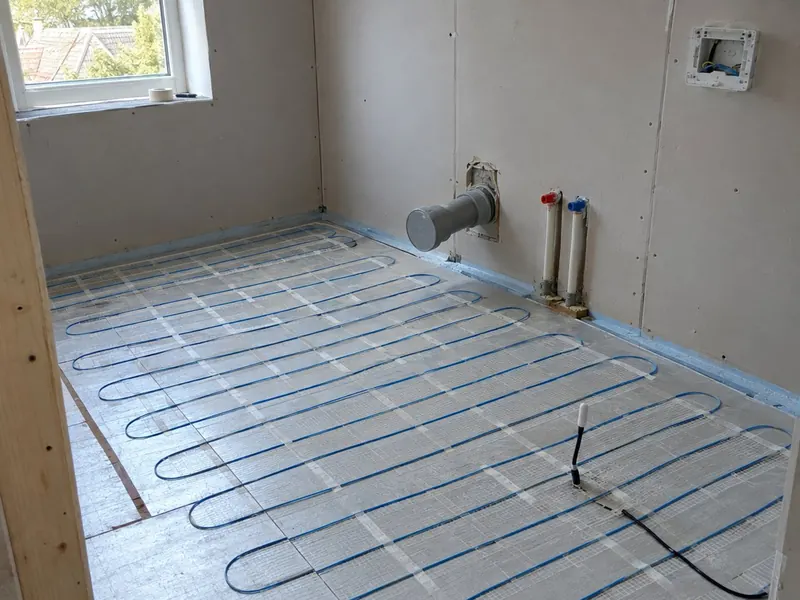
Being a smaller town does not change how we work in Bonnyrigg: free survey, written quote, one team. Whether your Bonnyrigg bathroom is a small en-suite or a large main bathroom, the mat is sized to the open floor, not the whole room. If your Bonnyrigg bathroom has a cold tiled floor and no room for a bigger radiator, an electric mat under new tiles is the simplest answer.
Water across much of the Lothians is soft. Soft water is kind to grout, so mid-tone and darker grouts stay looking fresh. Hardness varies street by street, so check the figure for your postcode with your water supplier.
What the job includes
- A dial, programmable or smart thermostat, with the supply RCD protected, tested and certified by a qualified electrician
- Resistance and insulation tests on the mat before, during and after tiling, with the readings recorded
- A floor sensor set between the heating runs and wired back to the thermostat
- A check of the floor construction, the room's heat loss and where the thermostat and supply will go
Decisions to make first
Floor finish
Tiles and stone pass heat through well. LVT and vinyl can work, but check the maximum floor temperature the flooring maker allows.
Insulation board thickness
Thicker boards warm up faster and lose less heat downwards, but raise the floor; the right choice depends on the door threshold and the next room.
Rules that apply in Scotland
Scotland has no Part P. Underfloor heating added during a straight bathroom refit rarely needs a building warrant on its own, but it must be installed, tested and certified to BS 7671 with RCD protection.