
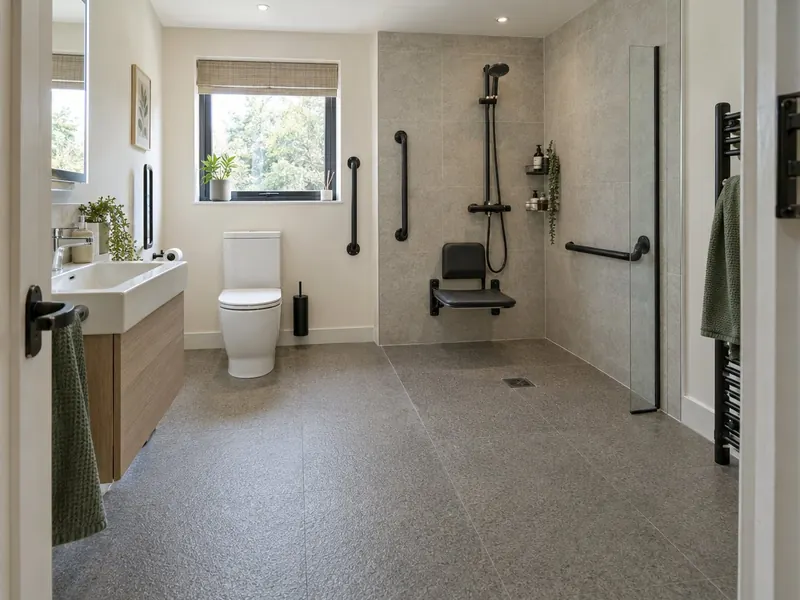
Can you get a grant for an accessible bathroom?
Yes. If someone in your home is disabled and needs a safer bathroom, such as a level-access shower in place of a bath, you can apply for a Disabled Facilities Grant (DFG) from your council in England and Wales or the Housing Executive in Northern Ireland, or for help under your council's Scheme of Assistance in Scotland.
Grants pay for adaptations needed because of the person's disability, not general improvements. Typical bathroom work includes:
- Replacing a bath with a level-access shower or wet room
- Fitting grab rails, a shower seat and a comfort-height WC
- Widening a doorway or changing the door for wheelchair access
- Providing a ground-floor bathroom where stairs are a problem
Owners, tenants and landlords applying for a disabled tenant can all apply; tenants need the landlord's permission for the work. Grants for adults are usually means-tested, so household income and savings are assessed and you may be asked to contribute. In England, grants for a disabled child are not means-tested.
The most important rule: the grant must be approved before work starts. Councils normally will not pay for work that has already begun.
How much is a Disabled Facilities Grant?
The maximum Disabled Facilities Grant is £30,000 in England, £36,000 in Wales and £25,000 in Northern Ireland; Scotland does not have a DFG.
| Nation | Scheme | Maximum | Apply to |
|---|---|---|---|
| England | Disabled Facilities Grant | Up to £30,000 | Your council |
| Wales | Disabled Facilities Grant | Up to £36,000 | Your council |
| Northern Ireland | Disabled Facilities Grant | Up to £25,000 | The Housing Executive |
| Scotland | Scheme of Assistance | No DFG; set by each council | Your council |
The maximum is a ceiling, not a typical amount. The grant is based on the approved cost of the work the person needs, less any contribution the means test sets. Some councils offer extra discretionary help above the maximum, so ask what is available.
For context, our guide prices for an accessible bathroom are £6,000–£10,500 for a level-access shower, £8,000–£14,000 for an accessible wet room and £6,000–£12,000 for a walk-in or low-level bath, including VAT before any relief.
What does the occupational therapist assessment involve?
An occupational therapist (OT), usually arranged through your council's social care team or, in Northern Ireland, your Health and Social Care Trust, visits to see how the disabled person manages at home and recommends the adaptations they need.
The OT looks at how the person gets in and out of the bath or shower, uses the WC and moves around the room, and how their needs may change. The recommendation sets out what is necessary and appropriate, for example a level-access shower with a seat rather than a bath lift. The council then checks the work is reasonable and practicable in your home, given the building and the cost.
- Ask for the OT's recommendation in writing. The design and quote should follow it closely, because the grant pays for the recommended work.
- Waiting times for an OT visit vary between councils, so make contact early.
- If you are paying privately, an OT can still advise on the design.
A survey of the bathroom sits alongside the OT's report: it checks the drainage, floor construction and space, which decide whether a level-access floor is possible.
How do you apply for a Disabled Facilities Grant?
You apply to your council, or the Housing Executive in Northern Ireland, usually after an OT assessment, with quotes for the recommended work, and then wait for written approval before any work starts.
- Ask for an assessment from the council or social care team.
- OT visit and written recommendation.
- Means test for adult applications, to work out any contribution.
- Quotes and plans for the work. Councils often ask for itemised quotes.
- Formal application, with proof of ownership or the landlord's consent and confirmation that the person intends to live there.
- Approval in writing, stating the approved amount.
- Work, inspection and payment, often paid direct to the contractor once the council is satisfied.
In England, the council must give its decision within six months of a valid application. Do not let anyone start until the approval letter arrives. An itemised written quote helps, because the council can see what each part of the work costs.
What help is there in Scotland?
Scotland has no Disabled Facilities Grant; instead, each council runs a Scheme of Assistance that offers advice, practical help and, for adaptations a disabled person needs, financial help such as a grant.
The process is similar. An occupational therapist assesses the person's needs, the council decides which adaptations are essential, and you need the council's approval before work starts. The amount and the rules on contributions are set within each council's scheme, so ask your council's housing or social work department how theirs works. Council and housing association tenants usually go through their landlord, who may carry out the adaptation directly.
Building rules differ in Scotland too. A like-for-like refit does not normally need a building warrant, but forming a new bathroom, altering drainage or structural work may. Converting a bathroom to a level-access wet room can mean new drainage, so check whether a warrant is needed before you apply.
VAT relief works the same way across the UK, including Scotland, because VAT is a UK-wide tax.
Can you get VAT relief on an accessible bathroom?
Yes. Building work to adapt a home for a disabled person's condition, including adapting a bathroom so they can use it, can be zero-rated for VAT under HMRC VAT Notice 701/7, and the relief is not means-tested.
Zero-rating means 0% VAT instead of 20% on the qualifying work and the goods fitted as part of it. It applies whether you pay privately or with a grant.
To claim it, the disabled person, or someone on their behalf, signs an eligibility declaration before the work, confirming their condition and that the work is for their use. The contractor keeps it on file; you do not send it to HMRC or pay the VAT and claim it back.
HMRC treats a person as eligible if they have a physical or mental impairment with a long-term and substantial effect on their ability to carry out everyday activities, have a condition doctors treat as a chronic sickness, or are terminally ill. Being elderly is not enough on its own, and neither is a temporary injury. The notice itself explains the tests and gives the declaration wording.
What bathroom work qualifies for zero-rated VAT?
Work qualifies for zero-rated VAT when it adapts the bathroom to suit the disabled person's condition; general improvements, or upgrades chosen for looks, are charged at the standard rate.
- Usually qualifies: replacing a bath with a level-access shower, forming a wet room floor, fitting grab rails and a shower seat, a comfort-height WC, widening a doorway, and extending or providing a bathroom where the condition makes it necessary.
- Usually standard-rated: redecorating, replacing a vanity unit for style, upgrading tiles beyond what the adaptation needs, and work in rooms the disabled person does not use.
Where a job mixes both, the quote should split the zero-rated and standard-rated parts so you can see exactly what carries VAT. A written, itemised quote makes this clear for you, the council and HMRC.
The relief covers the work of adapting the home and the goods fitted as part of that work, so qualifying items are simplest supplied and fitted together under one quote.
What makes a good level-access bathroom?
A good level-access bathroom has no step into the shower, enough clear space to move and turn safely, slip-resistant surfaces, and controls that are easy to reach and use.
- Floor: tiles laid to a gentle fall towards a drain, or a level-access tray set flush with the floor, in a slip-resistant finish.
- Space: a wheelchair user needs a turning circle of about 1,500 mm, and a carer may need room alongside.
- Shower: a thermostatic valve to limit the temperature, controls at a reachable height, a slide rail and a fold-down seat.
- Support: grab rails by the WC and shower, fixed into solid walls or timber fitted behind the boards.
- WC and basin: a comfort-height WC, lever taps and, where the person sits to wash, a basin with knee space.
- Door: a wider opening that slides or opens outwards, so it can be opened if someone falls against it.
- Contrast: rails and fittings that stand out from the walls help anyone with sight loss.
A wet room is often the most flexible layout, because the whole floor drains and there is no tray edge or door in the way.
Questions about this guide
Do I have to pay VAT on a disabled bathroom?
Not on the qualifying work, if the bathroom is being adapted for a disabled person's condition. The person signs an eligibility declaration and the work is zero-rated under VAT Notice 701/7. Upgrades that are not needed for the condition are still charged at 20%.
Can I get a Disabled Facilities Grant if I own my home?
Yes. Owners, tenants and landlords can all apply. Grants for adults are usually means-tested, so the amount depends on household income and savings, and the work must be approved before it starts.
Can I start the work and claim the grant afterwards?
No. Councils normally will not fund work that started before the grant was approved in writing. Wait for the approval letter before agreeing a start date.
Is there a Disabled Facilities Grant in Scotland?
No. In Scotland, councils help through a Scheme of Assistance, which can include advice, practical help and grants for adaptations. Contact your council's housing or social work department.
Guide prices include VAT and were reviewed in October 2026. Rules summarised here are general information, not legal advice; we check what applies to your home at the survey.
Add Fitted Bathrooms as a preferred source on Google