
Which type of shower is right for your home?
The right shower is the one that suits your hot water system: a mixer shower for a combi boiler or unvented cylinder, a pumped mixer or power shower for a gravity system with a cold water tank, and an electric shower where you want hot water independent of the boiler.
| Shower type | Combi boiler | Unvented cylinder | Gravity system |
|---|---|---|---|
| Mixer shower | Yes | Yes | Yes, but flow may be low without a pump |
| Power shower | No | No | Yes |
| Electric shower | Yes, from the cold mains | Yes, from the cold mains | Yes, from the cold mains |
| Digital shower | Mains-pressure version | Mains-pressure version | Pumped version |
The rule behind the table is simple: you must not connect a pump directly to the mains supply. Pumps, including the one inside a power shower, are only for gravity systems that draw from a cold water tank. On a combi or unvented system the water is already at mains pressure.
After the water system, the next questions are how much flow you have, where the controls will go and your budget.
How do you tell which hot water system you have?
Look for a hot water cylinder and a cold water tank: no cylinder means a combi boiler, a cylinder with no tank in the loft is usually unvented, and a cylinder plus a loft tank is a gravity system.
- Combi boiler: heats water on demand from the mains, with no cylinder. Shower flow depends on the boiler's hot water output and your mains pressure.
- Unvented cylinder: a sealed cylinder fed from the mains, usually with an expansion vessel and safety valves. It gives strong flow to several outlets at once, and it must be installed by a G3-qualified installer.
- Gravity (vented) system: a cylinder, often copper in an airing cupboard, fed by a cold tank in the loft. Pressure depends on the height of the tank above the shower, so it can be weak, especially on the top floor.
Some homes have a mix, such as gravity-fed hot water with mains-fed cold, which affects which mixer valve will balance properly. The home survey checks your system and measures pressure and flow before a shower is chosen.
How does an electric shower work, and what does it need?
An electric shower heats cold mains water as it flows through the unit, so you get hot water at any time without the boiler or a cylinder, but it usually needs its own dedicated electrical circuit.
Electric showers are sold by power, commonly 8.5 kW to 10.5 kW. More power gives better flow at a given temperature, especially in winter when the incoming water is colder. That power draws a large current, often 40–45 A, so the shower is wired on its own circuit from the consumer unit, with the right cable size and 30 mA RCD protection.
- Upgrading: replacing an old shower with a more powerful one may mean a new cable and circuit protection.
- Rules: in England and Wales a new circuit is notifiable under Part P; in Scotland and Northern Ireland the work is still tested and certified to BS 7671.
- Consumer unit: an old unit with no spare way or no RCD may need replacing, which is also notifiable.
An electric shower rarely matches a good mixer on mains pressure for flow, but it is simple and independent, which makes it a sensible second shower so two people can shower at once.
What is a mixer shower, and when does it suit?
A mixer shower blends hot and cold water from your existing supply, and it suits a combi boiler, an unvented cylinder or a gravity system with enough pressure; a thermostatic mixer is the safer choice because it holds the temperature steady.
A thermostatic valve reacts when someone flushes the WC or runs a tap elsewhere, so the temperature does not swing hot or cold. Most have a safety stop you press to go hotter.
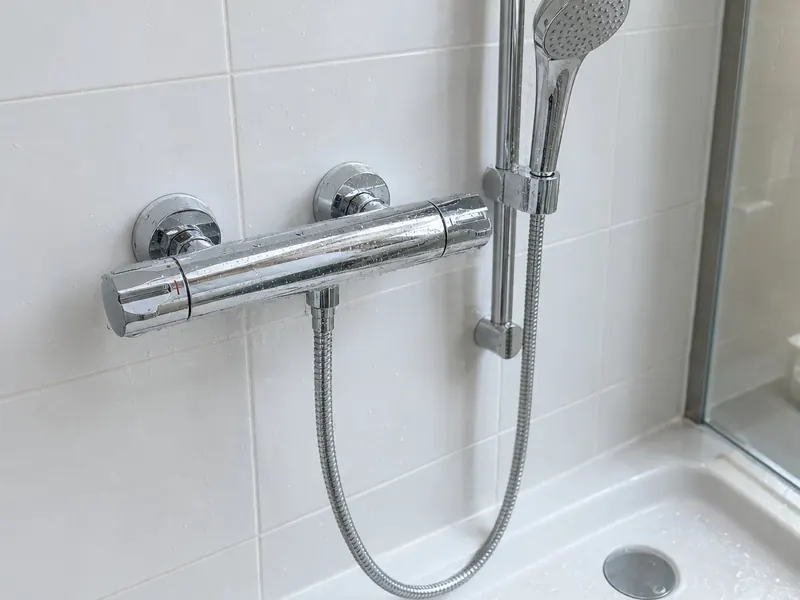
- Exposed bar valve: a horizontal valve on the wall with a riser rail and handset. Simple to fit and service, and it can go on an existing tiled wall.
- Concealed valve: the valve sits in the wall with only the controls showing, often feeding a fixed overhead head and a handset. It looks neater but must be planned before tiling, with a way to reach the valve later.
On a gravity system with a low cold tank, a shower pump can boost a mixer. In a new home in England, Part G limits hot water at a new bath to 48 °C, and thermostatic control is sensible for any shower.
What is a power shower, and why can it not go on the mains?
A power shower is a mixer shower with a built-in pump that boosts low-pressure water from a gravity system, and it cannot go on a combi or unvented system because the water fittings rules forbid connecting a pump directly to the mains.
Power showers draw hot water from the cylinder and cold water from the loft tank, then pump the mix to the head, giving a strong shower where gravity alone is weak. A separate shower pump does the same job for a standard mixer.
- Water stored: a pump uses water faster, so a small tank or cylinder can run out mid-shower, and the cold tank must refill quickly enough.
- Noise: the pump runs whenever the shower is on.
- Electrics: it needs an RCD-protected supply, positioned to suit the bathroom zones.
The rule on pumps applies across England, Wales, Scotland and Northern Ireland. If flow seems weak on a combi or unvented system, the cause is usually mains pressure, pipe size or the boiler's output, and a pump is not the answer.
Are digital showers worth it?
Digital showers are worth it if you want precise temperature, simple controls and a clean wall, because a hidden processor mixes the water and a slim controller sets it; they cost more and need power and a place for the processor.
The processor sits in a loft, airing cupboard or behind a panel and blends hot and cold water electronically. The controller can be wired or wireless, and some can start the shower from outside the enclosure or remember settings for different people.
- Versions: high-pressure models for combi and unvented systems, and pumped models for gravity systems only.
- Power: the processor needs an electrical supply, and a new circuit or work in the bathroom is notifiable in England and Wales.
- Access: the processor must be reachable for servicing.
With only a small control and a head on the wall, a digital shower suits wet rooms and walk-in showers. Large buttons and a set temperature also make it a good fit for an accessible bathroom, where twisting a valve can be difficult.
How do you check your water flow before choosing a shower?
You can check your flow by timing how long it takes to fill a container of known size from the existing shower or bath tap, then working out litres per minute.
- Use a bucket marked in litres, for example 10 litres.
- Run the shower or tap fully open and time how many seconds it takes to fill.
- Divide 60 by the seconds, then multiply by the bucket size. A 10-litre bucket that fills in 40 seconds means 15 litres per minute.
Test hot and cold separately where you can, then again with another tap running. Pressure, measured in bar with a gauge, is not the same as flow: you can have good pressure but poor flow through narrow or old pipes.
Then compare the result with the shower you like. Every valve and head states a minimum working pressure and the flow it needs, and large rainfall heads and body jets need much more than a standard handset. On a combi, the boiler's hot water output in litres per minute, shown in its manual, limits the hot side whatever the mains can deliver.
How much does it cost to fit a new shower?
A new shower costs £450–£1,000 to swap like for like, £800–£1,800 for a new thermostatic shower over a bath with a screen, and £1,500–£3,500 for a new shower with a tray and enclosure, supplied and fitted.
These are national guide prices including VAT. The price moves with:
- Valve type: a concealed valve takes longer than a bar valve, because the wall is opened and retiled.
- Electrics: an electric shower that needs a new or upgraded circuit adds the electrician's work and certificate.
- Pipework: a new shower position needs new hot and cold runs and a waste.
- Tiling and enclosure: often the largest part of the cost of a new shower area.
For a bigger change, a walk-in shower is typically £2,500–£6,000 and a bath to shower conversion £2,000–£5,000. See shower installation for what each option includes.
Questions about this guide
Can I fit a power shower with a combi boiler?
No. A combi supplies water at mains pressure, and the water fittings rules do not allow a pump to be connected directly to the mains. A thermostatic mixer shower works well on a combi without a pump.
Does an electric shower need its own circuit?
Usually, yes. Electric showers often draw 40–45 A and need a dedicated circuit from the consumer unit with RCD protection. In England and Wales a new circuit is notifiable building regulations work.
What shower works with low water pressure?
On a gravity system, a power shower or a mixer with a shower pump boosts the flow. On a mains-pressure system a pump is not allowed, so an electric shower, or a mixer and head matched to your measured flow, is the answer.
Is a thermostatic shower worth it?
For most homes, yes. A thermostatic valve keeps the temperature steady when other taps are used and has a safety stop to reduce the risk of scalding, which matters for children and older people.
Guide prices include VAT and were reviewed in October 2026. Rules summarised here are general information, not legal advice; we check what applies to your home at the survey.
Add Fitted Bathrooms as a preferred source on Google