- Postcode districts
- DL1, DL2, DL3
- Nearby
- Newton Aycliffe, Yarm and Stockton-on-Tees
- Guide price
- £400–£3,200
- Typical time on site
- half a day to 3 days
- Water
- Moderately hard across most of County Durham
- Survey
- Free, at your home
What does a new shower cost in Darlington?
Our guide price for a new shower in Darlington is £400–£3,200 including VAT. Labour costs in North East England put local prices at about 10% below the UK guide figure. The figure depends on the size of the room, whether anything moves, and the products you pick.
Shower swap
- Existing supply and position
New shower over bath
- Tiling the bath surround
New shower with enclosure
- Tray, enclosure and valve
Guide prices for Darlington including VAT. Your itemised written quote after the free survey is the price that counts.
Working in Darlington
As well as Darlington itself (DL1, DL2 and DL3), we survey in Newton Aycliffe, Yarm and Stockton-on-Tees.
Darlington has a wide mix of house ages, so the survey is where we spot old lead pipework, weak joists or a tight soil stack. We test pressure and flow at Darlington surveys before recommending a shower, so you know how it will perform before you buy. If you are replacing a failed electric shower in Darlington, we check whether the existing cable and circuit suit the new unit.
Most of County Durham has moderately hard water. A quick wipe of the glass and an easy-clean coating are worth having on a new shower in Darlington. Hardness varies street by street, so check the figure for your postcode with your water supplier.
What the job includes
- Removal of the old shower, a full-flow test and a handover on isolating and descaling it
- For an electric shower, a check of the consumer unit and whether a new dedicated circuit is needed
- Tiling or re-tiling around the shower, with tanking behind new tiles in the wet area
- Electrical connection by a qualified electrician, tested and certified
Decisions to make first
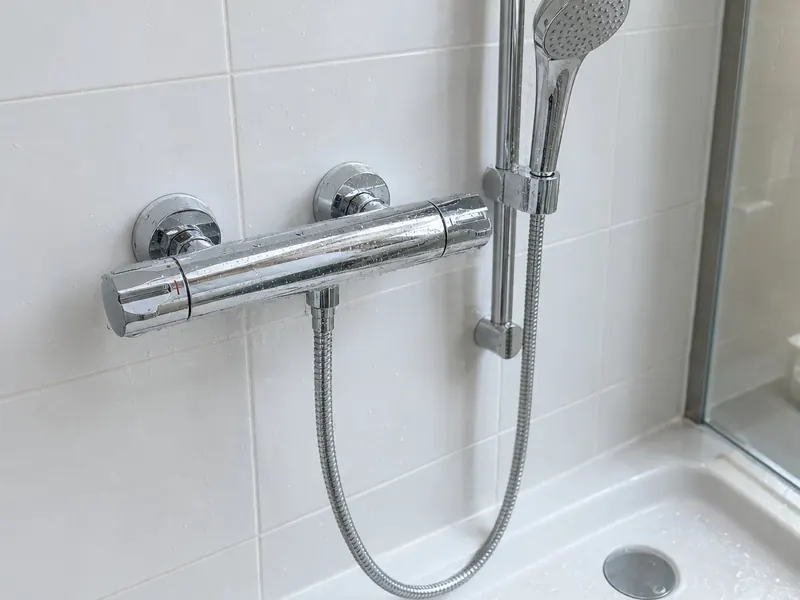
Thermostatic mixer
Blends hot and cold from your system and holds the temperature steady when someone runs a tap. The usual choice with a combi or an unvented cylinder.
Electric shower
Heats cold mains water as it flows, so it works without stored hot water. Higher kW units give more flow; 8.5 to 10.5 kW models need a dedicated circuit, often 40 to 45 amps.
Rules that apply in England
In England, an electric shower usually needs its own dedicated circuit, often 40 to 45 amps for an 8.5 to 10.5 kW unit, and a new circuit is notifiable under Part P. The Part G limit of 48 °C applies to a new bath in a new dwelling or one created by change of use, not to a shower, but a thermostatic valve gives similar protection. An unvented cylinder fitted to improve the shower must be installed by a G3-qualified installer.