
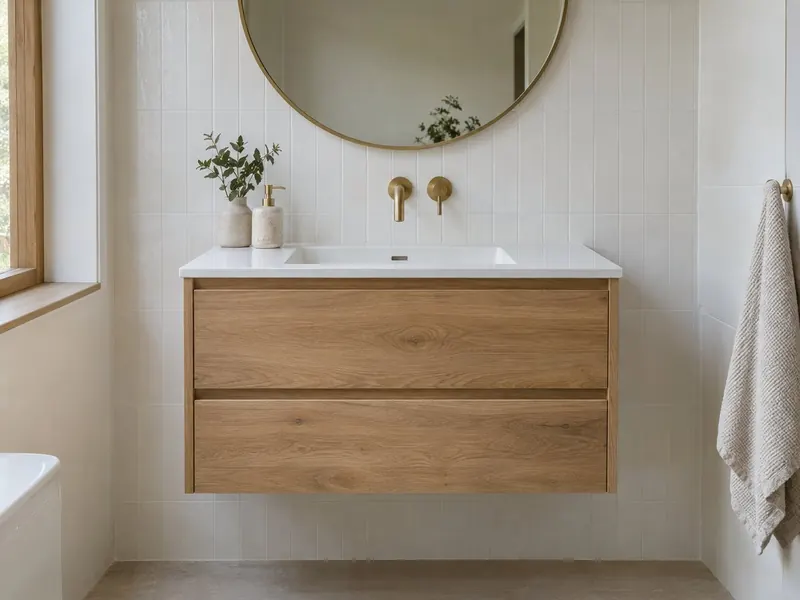
What does a new vanity unit cost in Gloucestershire?
Our guide range in Gloucestershire is £350–£1,550 including VAT.
Fit your unit
- Taps and waste connected
Supply and fit
- Removal of the old basin
Double or bespoke
- Double basin or long run
Guide prices for Gloucestershire including VAT. Your itemised written quote after the free survey is the price that counts.
Which towns do we cover in Gloucestershire?
Water across much of Gloucestershire is hard. Taps, plug wastes and toilet pans scale up quickly, so chrome copes better than matt black, and a removable aerator is worth having. Hardness varies street by street, so check the figure for your postcode with your water supplier. We quote vanity unit work in Gloucester after seeing the wall and pipework, so any re-tiling is on the quote from the start.
What the job includes
- A check that the wall can carry a wall-hung unit, with fixings to suit solid or stud walls
- A new tap, trap and the correct slotted or unslotted waste for the basin
- Isolation valves on the hot and cold supplies, so the tap can be changed later without draining the system
- Testing for leaks and checking the trap holds its seal
- Moving the waste and supply positions where the new unit needs them higher, lower or to one side
- Removal of the old basin and pedestal, or old vanity, and taking it away
Decisions to make first
Drawers or doors
Drawers keep things visible and reachable but lose some space to the trap. Doors give a deeper cupboard and cost less.
Waste and overflow
A basin with an overflow takes a slotted waste; one without needs an unslotted waste, often a push-button 'click-clack' type.
Basin type
An inset or semi-recessed basin, a one-piece moulded top, or a countertop basin on a worktop. Countertop basins need a tall tap or a wall-mounted one.
Width
Compact units around 400 mm wide suit cloakrooms; family bathrooms often take 600 to 800 mm for one basin and 1200 mm or more for two.
Rules that apply in England
Replacing a basin with a vanity unit does not need planning permission or building regulations approval. The new tap must meet the water fittings rules, including protection against backflow, and the waste should connect to the existing drainage through a proper trap. If the unit has a light, or a lit mirror goes above it, the electrical work must suit the zone it sits in under BS 7671 and be RCD protected.
In England, the tap and supply pipework come under the Water Supply (Water Fittings) Regulations 1999. A new waste connection to the soil stack can be Part H work, and adding a light to the unit or above it is notifiable under Part P.