
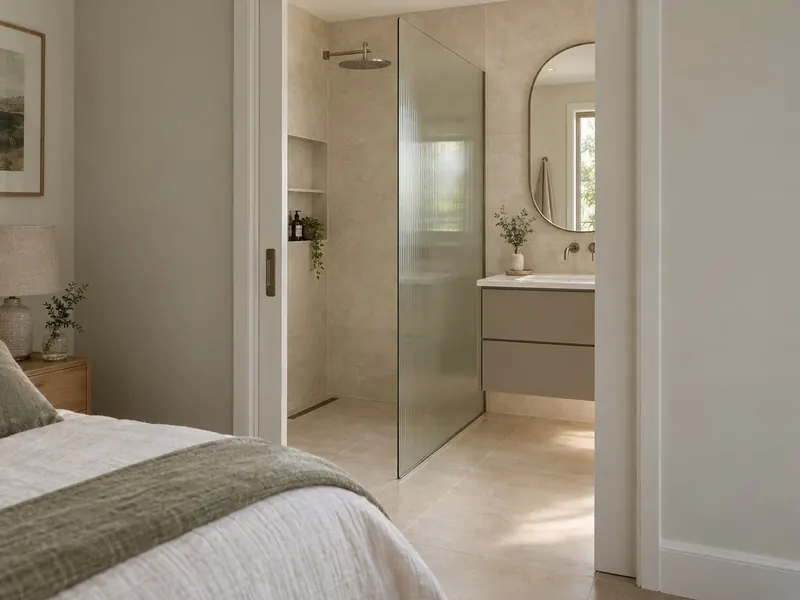
What does an en-suite cost in Renfrewshire and Inverclyde?
Our guide range in Renfrewshire and Inverclyde is £4,300–£8,600 including VAT. Prices in Renfrewshire and Inverclyde run at about 4% below the UK guide, based on Scotland labour rates.
Refit
- Shower, basin and WC replaced
Upgrade
- Full-height porcelain tiling
New en-suite
- Formed inside an existing bedroom
Guide prices for Renfrewshire & Inverclyde including VAT. Your itemised written quote after the free survey is the price that counts.
Which towns do we cover in Renfrewshire and Inverclyde?
Most of Renfrewshire and Inverclyde is supplied with soft water. If that holds for your street in Paisley, limescale on shower glass and heads builds up slowly and a squeegee after use is usually enough. Hardness varies street by street, so check the figure for your postcode with your water supplier. If the en-suite in your Paisley home was squeezed in by a previous owner, a refit is a chance to fix the door swing and the tray size.
What the job includes
- A shower tray or level-access former, an enclosure or walk-in panel, and a thermostatic valve
- An extractor fan ducted to outside, sized to the room and wired with an overrun timer or humidistat
- A survey that traces the route from the en-suite to the soil stack and checks the fall the waste pipes would need
- Tiling, silicone, testing and making good on the bedroom side of any new walls
- IP-rated lighting, a shaver socket and the electrics done by a qualified electrician, tested and certified
- A door that suits a tight space: inward, outward, sliding or a pocket door
Decisions to make first
Shower size
A 900 mm square tray is a comfortable minimum for an enclosure. In a long, narrow room, a 1200 by 800 mm walk-in tray with one glass panel feels far more generous.
Door type
An outward-opening door frees floor space inside. A sliding pocket door saves space on both sides but needs a stud wall long enough to take the cassette.
Refit or new en-suite
A refit keeps the existing drainage and walls. A new en-suite costs more because the walls, waste route, fan duct and electrics all start from nothing.
Exposed or concealed valve
An exposed bar valve is quicker to fit and easy to service. A concealed valve looks cleaner but sits inside the wall, so plan how it will be reached for repairs.
Rules that apply in Scotland
Forming an en-suite inside an existing bedroom does not normally need planning permission, but it is usually building-regulations work because it adds drainage, ventilation and electrics. All wiring must meet BS 7671, with 30 mA RCD protection on every circuit in the room. A macerator or pumped WC is acceptable only where the home also has a WC on gravity drainage. In a listed building, a new soil or vent pipe through a wall needs listed building consent.
In Scotland, forming a new en-suite may need a building warrant because it creates a new bathroom and alters drainage; refitting an existing one rarely does. The Technical Handbook uses the same 15 litres per second extract rate for a bathroom, and the electrics should be tested and certified to BS 7671.