- Postcode districts
- BS20
- Nearby
- Nailsea, Clevedon and Bishopsworth
- Guide price
- £700–£2,600
- Typical time on site
- 1–2 working days (added to a fit)
- Water
- Hard across most of Somerset
- Survey
- Free, at your home
What does bathroom underfloor heating cost in Portishead?
In Portishead, bathroom underfloor heating typically costs £700–£2,600 including VAT, based on South West England prices. The figure depends on the size of the room, whether anything moves, and the products you pick.
Electric mat
- Mat under the tiles
Electric, larger room
- Programmable smart thermostat
Wet system
- Screed or low-profile boards
Guide prices for Portishead including VAT. Your itemised written quote after the free survey is the price that counts.
Working in Portishead
We cover every part of Portishead, including BS20, and nearby Nailsea (3.5 miles) and Clevedon (4.7 miles).
Homes in and around Portishead vary, so we look at the floor, the walls and the water system before we price anything. If your Portishead home has a suspended timber floor, insulation boards under the mat stop heat disappearing into the void below. Where a Portishead home already has a heat pump, or the heating is being altered, a wet underfloor system is worth comparing with electric.
Water across much of Somerset is hard. Hard water leaves white marks on dark grout and gloss tiles, so matt finishes and stain-resistant grout are the practical choice. Hardness varies street by street, so check the figure for your postcode with your water supplier.
What the job includes
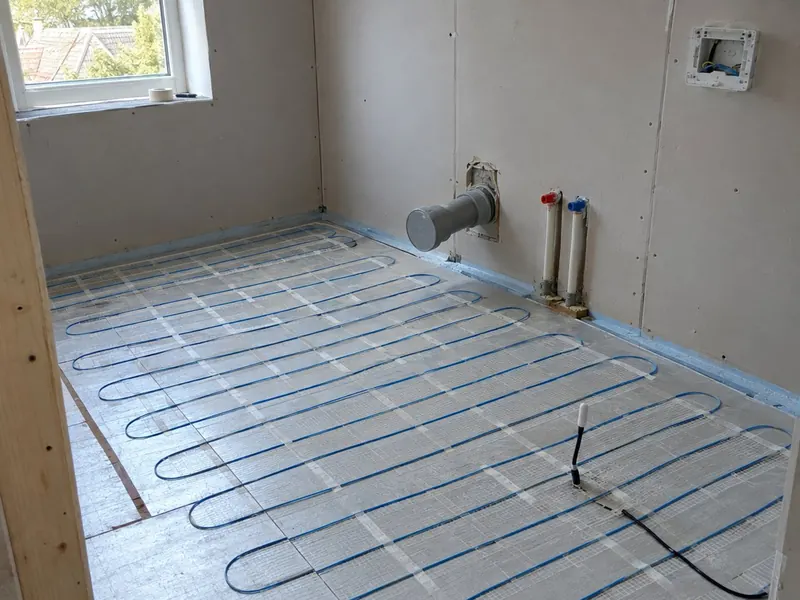
- The electric mat or cable laid to the open floor, kept clear of where the WC, bath and fixed furniture will sit
- Bringing the system up to temperature gradually once the adhesive and grout have cured
- A floor sensor set between the heating runs and wired back to the thermostat
- A check of the floor construction, the room's heat loss and where the thermostat and supply will go
Decisions to make first
Floor heating and towel rail
Underfloor heating warms the room; a towel rail dries towels. Many bathrooms have both, and a dual-fuel rail keeps working in summer when the boiler is off.
Insulation board thickness
Thicker boards warm up faster and lose less heat downwards, but raise the floor; the right choice depends on the door threshold and the next room.
Rules that apply in England
In England, a new circuit for underfloor heating is notifiable under Part P, and so is connecting it to an existing circuit in a room with a bath or shower. The electrician either self-certifies through a competent person scheme or the work is notified to building control.